
Archive for February, 2010
Consultation on changes for the policy of tall buildings: until 12.00 noon Friday 12 March 2010

Message received from Wandsworth Borough Council
Dear Sir/Madam
Wandsworth Local Development Framework
Consultation on changes to the Core Strategy proposed during Hearing Session 5 in respect of tall buildings
The Core Strategy Development Plan Document (DPD) sets out the Council’s spatial vision, strategic objectives and spatial strategy on how the borough should develop over the next fifteen years along with core policies and information on monitoring and implementation. The Core Strategy is part of the Local Development Framework (LDF), which will eventually replace the Unitary Development Plan (UDP) adopted August 2003.
Wandsworth Council submitted its Core Strategy to the Secretary of State for examination on 20 March 2009. The public hearing sessions, which form part of the examination, were undertaken on 2nd, 4th, 9th, 11th and 16 February 2010. Throughout the course of the hearing sessions a number of matters were raised which resulted in the Inspector requesting the Council to propose changes to the Core Strategy. These changes were made available on the 12th February 2010 and discussed at the final hearing session on the 16th February 2010. The full schedule of proposed changes is attached.
Prior to closing the final hearing session, the Inspector confirmed that the majority of proposed changes are of a minor nature, intended to provide more clarity within the Core Strategy but that she wished to further consider the change to policy IS3(d) and supporting text in paragraph 4.132 in respect of tall buildings (changes 12 and 13).
The Inspector has since confirmed that she regards most of the proposed changes to be in the nature of clarification (i.e. referring to the focal points of activity by name, and ‘signposting’ to detailed work being carried forward in other DPDs). However, the Inspector considers that the omission of reference to locations which are well served by public transport may be seen as significant by those with an interest in such locations and has therefore instructed the Council to undertake a targeted round of consultation for a period of 21 days.
You are being consulted on the latest change to Policy IS3 and supporting text in paragraph 4.132 (changes 12 and 13 of the attached document) as a party who made representations on the proposed submission Core Strategy and/or changes made to the Core Strategy Submission version, in relation to tall buildings. Only comments in relation to changes 12 and 13 will be accepted, any comments in relation to other policies will be returned to you and will not be considered.
Consultation on the Council’s proposed changes will begin Friday 19 February 2010. Representations on the soundness of the changes must be received by 12.00 noon Friday 12 March 2010 at the latest. Any responses received after this time will be returned to you and will not be considered.
Please direct all responses by email to planningpolicy@wandsworth.gov.uk or write to the Planning Policy Team, Wandsworth Council, The Town Hall, Wandsworth High Street, London SW18 2PU.
A hard copy of this email will be sent to you shortly. We look forward to receiving your views.
Yours faithfully,
Martin Howell
Group Planner – Policy & Information
for Borough Planner
You can read our related articles:
Clapham Junction Exemplar Streetscape plan – is it good enough?
Author: Mary Ann Tarver
The council’s exemplar streetscape plan has several welcome aspects. It should certainly make crossing the road at the main crossroads (St John’s Hill, Lavender Hill, Falcon Road, St John’s Road) much easier and safer – as long as sufficient time is given to the ‘green man’ phase and we don’t have to wait too long for the pedestrian phase. The plan to remove the railings and ‘sheep-pens’ at this crossroads will remove obstructions for pedestrians, enable the footway to be widened and make it safer for cycling. Removing the c
entral railings along Lavender Hill to enable drivers to turn right into Falcon Lane will reduce journey times for those travelling north and should reduce motor traffic congestion at the crossroads. It will also make it easier for those on foot to cross Lavender Hill.
The plan, however, does little to reduce the dominance of motor traffic. The Battersea noise maps shows how intrusive this is. Diverting traffic down Falcon Lane merely transfers the noise and congestion onto this narrow road past the entrance to two supermarkets. The Mayor’s Transport Strategy has the aim of reducing CO2 emissions by 60% from 1990 levels by 2025. It’s difficult to see how this target can realistically be achieved without reducing motor traffic volume and speed.
The council claims to wish to make Lavender Hill safer for cycling by means of cycle lanes on both sides. A glance at the the Department for Transport’s ‘Cycle Infrastructure Design’ (Local Transport Note 02/08, October 2008) will discover how far these diverge from published standards and guidelines for safe street design. Lavender Hill has, and will continue to have, a single yellow line which means drivers can stop to unload/load or just nip into a shop. This blocks precisely that part of the road where the Council plans for cyclists to go. Installing a cycling ‘facility’ which is of such questionable use is surely a waste of public money.
The DfT has a great deal of guidance for councils on designing streets for safety, not only for cyclists but also for pedestrians. For instance:
“Cycle lanes are not always suitable and may encourage cyclists to adopt inappropriate positioning if the lanes are poorly designed. Designers need to decide whether a cycle lane is going to help or not. If so, its alignment should ideally reflect guidance and training on safe techniques (Franklin, 2007)** for manoeuvres undertaken by cyclists….” (LTN 2/08, Cycle Infrastructure Design, DfT, October 2008, para 7.1.4)
And:
“On high streets with many side roads, bus stops, kerbside parking and accesses, there can be many cross-movements for cyclists to contend with. They may be little benefit in providing cycle lanes in situations like this (see Figure 7.1 [1]).” (LTN 2/08, DfT, October 2008, para 7.1.5 – figure 1 shows a situation very similar to Clapham Junction [1]).
Also:
“A cycle lane in the downhill direction can make conditions worse for cyclists. As a cyclist’s speed increases, the speed differential with motor traffic speeds reduces or disappears, and the cyclist needs to take up a more prominent position further from the nearside kerb. This helps ensure that drivers waiting to join from a side road can better see them and helps drivers behind to judge when it is safe to overtake. A single cycle lane of the recommended width going uphill is far preferable to sub-standard cycle lanes in both directions…” (LTN 2/08, DfT, October 2008, p35, para 7.1.6).
I would add it makes it easier for a pedestrian wanting to cross the road to see a cyclist in the running lane than close to the kerb. It also makes it easier for a cyclist to avoid the pedestrian who steps off the footway thinking the road is clear.
Alongside the exemplar ‘streetscape’ plan, the Council has worked with Network Rail to reopen the Brighton Yard entrance which gives access to the station over-bridge and lifts. This should reduce passenger congestion in the under-pass as just under one third of rail passengers approach the station from the Wandsworth direction. However, there will not be a crossing located here to enable those who need the lifts to get to them from the other side of the road. There will be covered cycle parking for the station in Brighton Yard, but there is no plan to facilitate the right turn into Brighton Yard from St John’s Hill so that cyclists can gain access to it from the Battersea direction, nor for the right turn out of it for those whose route is in the opposite direction. The footway on the station side from the existing crossing will not be widened as far up as this. On the contrary, a bus stop is planned, which, while good for access by bus passengers, will congest the footway even more.
The Council’s rationale for failing to provide for safe and convenient access into Brighton Yard is the lack of visibility for drivers coming from the Wandsworth direction over the rail bridge. As we know, the crossroads are in a valley formed by the Falcon Brook. Yet the ‘exemplar’ plan has no proposal to reduce motor traffic speed. Recent research on 20mph zones across London found that they resulted in a 42% reduction in traffic casualties (Grundy, et al, 2009). Reductions in both number and severity of deaths and injuries applied to all road users. Not surprisingly, the greatest beneficiaries were younger children. Perhaps more surprisingly, a considerable casualty reduction was also found in drivers.
An additional benefit of having safer roads is the reduction in noise and fear. For at least half a century we have gradually come to accept the domination of motor traffic on our streets, but as Living Streets (formerly the Pedestrians Association) say “It doesn’t have to be like this”. Rod King of the ’20′s Plenty’ campaign points out the difference between the ‘Go Ahead’ Councils and the ‘Can’t be Done’ Councils. Increasingly throughout the country the ‘Go Ahead’ are responding to demands for safer streets and are making all their streets 20mph. This includes major cities like Portsmouth and Oxford. Nine London Councils are currently planning it.
Reducing the volume and speed of motor traffic can transform our streets. By returning our streets to life we can contemplate reversing the increasingly sedentary lifestyle which is responsible for the obesity and lack of fitness in our population. Children can be freer to walk and cycle to schools, parks, visit friends. We will be able to let go of the belief that the only way to travel safely on roads is by car. Projects abound to encourage us to be more active. But what is the point of exhorting parents and children to walk or cycle to school, for example, if the streets are not made safe or convenient enough for them to do so?
The Department for Transport has recently issued new guidelines which aim to help Councils to adopt local authority-wide 20mph limits. Experience where an authority-wide 20mph speed limit has already been introduced has shown that it can be done without the need for speed bumps or other ‘calming’ devices. Drivers report they like the ‘default’ 20mph limit because it reduces their stress and saves fuel (Social Attitudes 2005) while not affecting the duration of their journey. With proof that it can save deaths and severe injuries, reduce fear of traffic, and make a town centre as well as local streets more attractive, what excuse can there be for not introducing a ‘default’ 20mph speed limit in our own borough, particularly in a motor traffic-dominated area like Clapham Junction?
[1] Franklin, J. 2007. ‘Cyclecraft’, 4th edition. London: The Stationery Office.
Read also our previous article on the Exemplar Scheme HERE.
Nine Elms: some pictures of the project
Author: Cyril Richert
To complete our previous article on the final project in Nine Elms last July and the schemes around the Battersea Power station, I have collected some screen-shot from the movie displayed on the official website to present the project of redevelopment (click on the photos to see bigger).
You can read also comments on the video on Cllr James Cousins’ blog.
In a recent article published by the Wandsworth Guardian, the Mayor of London said that plans to redevelop Battersea Power Station have met with the broad approval, but the scheme needs to offer more affordable housing. Boris Johnson told Real Estate Opportunities (REO), which owns the iconic station site, said the scheme did not comply with the London Plan and he expects the “maximum reasonable amount” of affordable housing.
Crossrail to Clapham Junction
Author: Cyril Richert
As I was recently browsing the Council’s website looking for some boring documents on planning
I discovered the very interesting page (actually it is more a portal) dedicated to Clapham Junction.
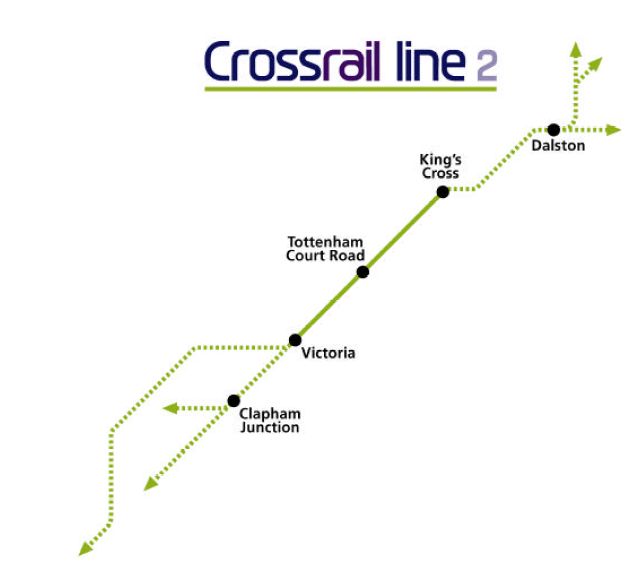
Of course most of the subjects are already on our website, such as the East London Line, direct rail services to Heathrow, or Brighton Yard. However I read with interest the article about the long delayed Crossrail 2 project with should direct link Clapham Junction to the West End and Kings Cross/St Pancras.
This project was previously known as the Chelsea-Hackney Line. It is significantly cheaper than Crossrail 1 which is costing £10 billion and will not bring any direct benefit to Clapham Junction or south London.
Two routes through Chelsea and Battersea have been identified for the line. Either option would provide direct links to the Underground network and relieve congestion on lines into Victoria and Waterloo.
There would also be a direct service to the Eurostar terminus at St Pancras. The Battersea option could have a new stop in north Battersea.
The current Crossrail 1 scheme, on which construction work has now started, will run through central London from Heathrow to Stratford. Services are due to start in 2017.
For up to date information visit www.crossrail.co.uk.
Despite some early map as below showing a branch south from Victoria Station underneath Battersea Park in the direction of Clapham Junction (shown as an interchange with Crossrail 2 on TfL’s East London Line route map), Crossrail 2 still has no timetable (2025?)
Leaflet
Author: Cyril Richert
The Clapham Junction Action Group has published a new leaflet available on the link here.
We intend to distribute the leaflet from the 13 February onward and are looking for help. If you can spare 1 or 2 hours helping to distribute some papers in the vicinity of Clapham Junction before the end of February, please contact us here.
Exemplar scheme
Author: Cyril Richert
The Council is now ready to start road works in Clapham Junction town centre to improve the traffic, redesign the cross-roads, refurbish the pavements and provide several more facilities.
A report on feasibility study into improving the Town Centre was published in June 2007 and examined by the Transport Committee (part of the Exemplar scheme aiming at improving Town Centres).
We have already commented in February 2009 on part of the Exemplar Scheme affecting the road system around Clapham Junction, for vehicles and for pedestrians.
The scheme was estimated to cost £3m (in the report to the Committee), including £800k coming from TfL money and allocated by the Council to the Junction. However the recent article published in Brightside in January talk about £1.2m (click on the article to see bigger).
I found an excellent presentation of the scheme on the Council Website HERE (I re-use part of the article below as with my experience information on the Council website tend to move and links being lost).
- make the area safer and more attractive and convenient for pedestrians and
- enhance journey times for general traffic, buses and cyclists
Transport proposals
The main changes to local streets and footways will be:
- Redesign of the junction of St. John’s Hill, Lavender Hill, Falcon Road and St. John’s Road to provide improved pedestrian crossing facilities. This will include a diagonal crossing to make it easier for pedestrians to get across the junction between the Falcon Pub and Debenhams Department Store;
- Introduction of a right turn into Falcon Lane from Lavender Hill. This will include a banned right turn from Lavender Hill onto Falcon Road
- Movement of the taxi rank from it’s current position to a site further along St John’s Hill;
- Improvements to the junction of the Falcon Lane and ASDA car park access road ;
- Introduction of a keep clear area, within the existing mini-roundabout between Falcon Lane and Falcon Road;
- Widening of the pedestrian crossing outside the railway station to give pedestrians more space;
- Amendment of bus stop locations on St John’s Hill to combine service stops;
- Introduction of cycle lanes along Lavender Hill in both directions between the junctions with Falcon Lane and Falcon Road to improve cyclists’ safety; and
- Amendments to the waiting and loading restrictions in the area.
Streetscape proposals
Proposals include improved conditions for pedestrians and a clear and barrier free streetscape through:
- Reduction of guard railing
- Straight and direct crossings
- New public spaces
- Creating furniture zones for street furniture, taxi ranks and bus stops along the road
- Creating a clutter-free movement zone for pedestrians close to the buildings
- Durable materials for paving, lighting, benches, bus shelters
- Repaving of large sections of the pavements with large sand coloured slabs
- More trees
- Providing cycle parking away from the congested pavements
Site Specific Allocation Document: submission
Author: Cyril Richert
As I said last week, the consultation on the Site Specific Allocations Document deadline is today, February 5th. The Planning Officer explained last week that a statutory notice was published in the Wandsworth Guardian and a few posters displayed in some estates. “Unfortunately” the Council missed the deadline for Brightside!
However, regarding the poor handling of the consultation it was said that any submission post-deadline could be considered.
Presentations can be send by email to: planningpolicy@wandsworth.gov.uk
or by post:
Planning Policy, Technical Services Department,
Town Hall, Wandsworth High Street,
London, SW18 2PU
Forms can be found in local libraries. You can also contribute directly on the Council’s website HERE.
I have managed to draft a submission that you can download in full HERE (pdf).
Quoting many letters of objection focused on the detrimental impact on community that a development with high rise towers would bring, I wrote:
It is clear to us that the location of Clapham Junction is unsuitable for tall building and the erection of high rise development will bring a detrimental impact on the neighbourhood and will destroy the human-scale/village feeling of the area.
The Council has already acknowledge that point in the Core Strategy document as amendment was made (Policy PL13 – Clapham Junction and the adjoining area – page 198, clause e) to remove reference to the Clapham Junction Station site being potentially suitable for tall buildings.
However the SSAD currently describes areas with words such as “tall buildings may be justified in this location”. The Clapham Junction Action Group does not consider that the borough’s evidence supports a justification of any of tall building locations as justified. Density (that can be justified with the PTAL rate of Clapham Junction) and tall buildings are two different concepts.
Therefore, as it is still apparent in the SSAD, we recommend that the proposed size limit for Clapham Junction area be limited to 5-6 storey (below the size of Arding & Hobbs rotunda) maximum and taller buildings (6 storeys) be located along the railway.
Proposed amendments regarding Clapham Junction SW11 (p87-93 of the SSAD):
General map for building size: (Changes have been put in dark red)
Amendments specific to 4.1 Area Spatial Strategy for ASDA, LIDL and Boots sites, Falcon Lane, Clapham Junction SW11
Tall Buildings: […] Applications for buildings of more than 20 6 storeys are unlikely to be considered acceptable […]
Amendments specific to 4.3 Clapham Junction Station Approach, SW11
Design Principles: […] The existing subway would only be used for passengers transferring between platforms Both usage of subway and overpass should be kept open for passenger usage and accessed to change platforms as well as entering/exiting the station. A proper and enlarged concourse should be created to the main entrance of the station and internal access to Brighton Yard and St John’s Hill entrances ought to be provided. […]
Tall Buildings: […] On the majority of the site, applications for buildings of more than 20 6 storeys are unlikely to be considered acceptable […]
Amendments specific to 4.5 Land at Clapham Junction station, SW11
Preferred option: Residential Mixed use development to capitalise on the existing excellent rail connections into and out of London which will be improved even further by the East London Line extension and encourage one or more major employers to base themselves in this Town Centre; other appropriate uses include business, hotel, cultural, leisure and entertainment.
Alternative Options considered at Issues and Options stage: Residential only redevelopment, office only redevelopment.
During the public hearing on the Core Strategy examination, Thursday 4 February at the Town Hall, the inspector made the point that developers will look at any suggested maximum and see it as the green ligh t from which to start.
The point was made also about the recommended proposals / current approvals breaching them. Inspector asked for clarification of the time lapse between the old UDP and the new LDF.
We will report about the public hearing in another article…
Public Hearing: Examination of the Wandsworth Core Strategy
Author: Cyril Richert
The Core Strategy (CS – which sets out the Council’s vision on the development of the borough for the next 15 years – more explanation here), part of the Local Development Framework (LDF) for Wandsworth borough, was submitted to the Secretary of State in March and is now being examined by an independent Planning Inspector.
Hearing sessions have started on Tuesday 2 February (agenda here). The CJAG has been invited to speak to by the Planning Inspector at Session 2 which is Thursday 4 February starting at 10.00 am (Committee Room 123, Wandsworth Town Hall – public welcome), with the main subject on tall buildings. We have already expressed our views in a joint statement sent and published with the Wandsworth Society, the Putney Society and the Battersea Society. John Dawson, chair of the Wandsworth Society will be talking on our behalf at the hearing.
Themes and main issues for discussion have been published by the inspector (I made a few comments in dark red)
Design/townscape in general (scale and density of development)
Matters for discussion:
The role of the London Plan Residential Density Matrix in assessing the maximum intensity of use compatible with the local context, good quality design and public transport capacity
- should Policy IS 3(c) distinguish between scale and density of development in parts of the borough where the local context is not expected to change significantly, and parts where regeneration/intensification will change the area’s setting (built form, proximity to town and district centres) and public transport accessibility?
- range of densities appropriate and relevant to Wandsworth?
One rule used in the London Plan for assessing density is the PTAL (which stands for Public Transport Accessibility Level). It is a method used in transport planning to assess the access level of geographical areas to public transport (originally used by London Borough of Hammersmith and Fulham, and was later adopted by Transport for London as the standard method for calculation of public transport access in London).
In the case of the Ram Brewery scheme (two tower blocks of 32 and 42 storeys and about 1000 flats approved by the Council in a major development in Wandsworth, later called in by the Secretary of States with a public inquiry last November), one representative of the developers said that Wandsworth Town Station could take extra passengers, and was not overcrowded at peak times as, when it rained, it looked as though the train was full because passengers did not want to walk up the platform and get wet! This was his case for the station having more shelters. He also made an assumption the development would only generate approximately 80 additional passengers therefore it would have no impact.
However it is acknowledged that Wandsworth Town station operates in excess of 116% already. Engineering services have also assessed that 62.3% of trains leaving Wandsworth Town for Central London in the morning peak are considerably over capacity with no room to absorb any supplementary passengers. Some bus routes (i.e. #220) leaving Wandsworth in the morning are also over capacity.
In the case of Osiers Estate (a scheme including a 21 storey-tower approved by the Council in January 2010 with 275 flats), this problem is demonstrated by the adjoining Riverside Quarter development finding it necessary to provide its own mini-bus service to stations and bus stops.
“At 1067hrph when taking into consideration the commercial uses (852hrph for residential only) the proposed density is in excess of both the urban and central setting for a maximum PTAL of 2 within the London Plan. For urban character areas with a PTAL of two to three the London Plan provides a guidance of 200-450hrph. For central character areas with the same PTAL the guidance is 300-650hrph.” This is stated in the report of the planning officer for Osiers Estate (p53)!
Surrounded areas are also in breech of the current rules as set in the London Plan: the consented WRQ phase 3 density is 899hrph and the riverside development of Battersea Reach is 883hrph. The developers of Osiers Estate have justified their high density because “a number of high density scheme have been permitted in the vicinity of the site” already!
With more than 2000 additional flats to be built in the area of Wandsworth town and already approved by the Council, one wonders what consideration – if any – was given to the long term issue.
As the Council is currently approving schemes that are in breach of current policies, we have doubt on the soundness of any new policy which won’t be made compulsory and would use vague term such as “acceptable with exceptional circumstances” (without explaining exactly what they are, others than saying they benefit to the community)!
The relationship between the London Plan Residential Density Matrix and the Vauxhall Nine Elms Battersea Opportunity Area Planning Framework
- density assumptions underpinning housing capacity estimates in the CS and the evidence base; consistency with the London Plan and CS Policies IS 3 and PL 11
Tall buildings
Issue: The strategy identifies areas where tall buildings might be appropriate.
- is the evidence supporting this approach and the changes proposed to Policies PL 11, PL 12, PL13, PL14 and IS 3 based on up-to-date information on the environmental characteristics of the area (PPS 1)?
- does it demonstrate an understanding and evaluation of the defining characteristics of the area (PPS 1)?
- does it respond to the local context and create, or reinforce, local distinctiveness (PPS 1)?
- does it pay special attention to the desirability of preserving and enhancing historic areas and buildings (PPG 15)?
In identifying areas where tall buildings may be appropriate, what regard has been given to the good practice guidance currently available?
Policy IS 3 of the Core Strategy – Submission version states that tall buildings may be appropriate in locations which are well served by public transport, such as town centres, or at other defined focal points of activity, providing they can justify themselves in terms of the benefits they bring for regeneration, townscape and public realm. In the current UDF there is no specific size definition.
Emerging policy, currently out for consultation, in the LDF to guide tall building proposals suggests that the criteria sets out in the CABE/EH guidance will apply to building over X storeys and that buildings over Y storeys are unlikely to be acceptable, and will only be considered in exceptional circumstances.
We hope that the new size limits specified in the Site-Specific Allocations Document – Preferred Options (SSAD1 & SSAD2) do not come out of thin air, and we can reasonably assume that they are based on solid arguments. Therefore, we have difficulties understanding why those arguments are not used in current planning applications! An example? Osiers Road again, where the SSAD says that “applications for buildings of more than 18 storeys will generally be unacceptable, and will only be considered in exceptional circumstances” but a 21-storey tower and high density (contradictory to London policy framework) were quickly approved by the Council on January 7th.
As the Council is considering apparently that arguments used to draft the new CS submitted to the Inspector are not relevant, what certification can we have that they will seriously endorse and follow the “substance” of policy examined by the Inspector instead of overturning the meaning?
Discussion of this issue having regard to:
Stage 1 Urban Design Statement
- time frame and purpose of the research/analysis referenced
- audit trail between documents referenced in the study and the development of the CS tall buildings strategy
- non-townscape considerations
Stage 2 Urban Design Statement
Site Specific Allocations Document (SSAD)
Development Management Policies Document (DMPD)
Issue: Is the CS approach consistent with the London Plan policy to manage and protect strategic views, including the Palace of Westminster?
- protection of the Palace of Westminster World Heritage Site (WHS) and advice in Circular 07/2009
- English Heritage (EH) proposed change in relation to the WHS
The new policy is suggesting buildings up to 40 storeys for the area of Nine Elms (p77 of SSAD2). In a recent document, the redevelopment of the current Flower Market site (10 acres), is pictured to include three buildings of varied height, the tallest of which could be 46 storeys in height (therefore already in breech of the emerging SSAD). As we wrote previously, the height will be between 155 and 200m. It will echo the concerns raised with the previous plan to raise a 250m glass tower beside Battersea Power station; at the time, opponents (including English Heritage) said: “The impact of the new tower on the Houses of Parliament and the Westminster World Heritage Site will be disastrous“.
Issue: How will schemes involving proposals for tall buildings be assessed pending the adoption of the SSSAD which will provide more detailed advice on individual sites and the DMPD which will set out the criteria referred to in Policy IS 3?
- anticipated time frame for adoption
- assessment during the transitional period
Issue: Is the definition of “tall building” sufficiently clear?
- English Heritage suggested changes to the definition
- the additional change proposed by the Council, drawing attention to the DMPD and the SSAD
Discussion of consolidated changes to Policy IS 3(d) proposed by EH
As we said above, we have doubt of whether the use of such vague wording as “acceptable under exceptional circumstances” without more definition could be used by the Council to pass any scheme, assuming it provides enough benefits for the area in term of cash under Section 106 (i.e. will the developer needs just to pay a bit more to get its scheme approved?)
In its presentation, EH said:
“It is English Heritage’s view that the current definition of “tall building” included in Policy IS3 is not sufficiently clear. It is our experience that the phrase “significantly exceed” requires further definition in order to provide sufficient clarity as to what it means. In order to help overcome this, English Heritage has sought to amend this by replacing it with the phrase “are substantially taller than their neighbours and/or which significantly change the skyline”.” [EH arguments can be read HERE]
This is exactly what we said in our joint statement on tall buildings:
““Tall” buildings, those significantly taller than their neighbourhood, must be considered in their urban context.“
Major development areas and sites
Vauxhall Nine Elms Battersea Opportunity Area/Battersea Power Station
Issues: Does the Core Strategy provide a clear framework for the regeneration of this strategic development area and the timing/phasing of development, particularly in relation to the provision of essential infrastructure and the decommissioning of the gas holders at Prince of Wales Drive?
Are the development, transport and environmental strategies proposed in the OAPF matters which ought to be dealt with in the Core Strategy (or other Development Plan Document subject to independent examination), rather than non-statutory planning guidance?
- CS, OAPF and SSAD, including the Area Spatial Strategy: status, roles and interrelationships
- the relationship between the CS Infrastructure Delivery Table and the OA Planning Framework Infrastructure Study
- improving clarity about the phasing of development
- synchronising the phasing of development in the medium-long term with the provision of essential infrastructure and overcoming other constraints on development
Issue: Should the quantum and mix of development referred to in Policy PL 11 be subject to an early review, in the light of progress on the OA Planning Framework? Where development in the OA has potential implications for other CS policies, should these also be subject to review?
- CS envisages 8,000 jobs and 3,500 dwellings within the CAZ by 2026, compared to OAPF preferred option of 27,000 jobs and 16,750 dwellings. Would the Council’s suggested change to Policy PL 11 be sufficient to address this significant increase in the quantum of development?
- changes suggested by Treasury Holdings Ltd
Issue: Is Policy PL 11 sufficiently clear about the type, quantum and form of development the Council seeks to secure on the Battersea Power Station site, in particular, the scale and role of the Central Activities Zone (CAZ) retail frontage proposed in the Opportunity Area?
- tension between the CS, the OAPF and development proposals
Issue: Has all key infrastructure essential to allow the development potential of the opportunity area to be realised, been identified and justified, and is it clear how and when it will be delivered? How will the delivery of infrastructure be synchronized with development? Is the consolidation of the New Covent Garden Market onto the main site dependent on the provision of improved public transport infrastructure and capacity?
- decommissioning of Prince of Wales Drive gas holders (?); details of “enhanced” public transport; East London line extension – in text but not Infrastructure Delivery Table (IDT); details of social and community infrastructure and educational infrastructure (in IDT but not text); public open space (not in text, proposed change to IDT)
- dealing with unknown costs and “variable” or “ongoing” delivery timescales
- OAPF Infrastructure Study – process and timing
- New Covent Garden Market consolidation
Clarification: How will a satisfactory relationship between the development of new homes along the riverside, safeguarded wharfs and other sources of potential noise and environmental nuisance be ensured?
Clarification: Although mentioned in the OA Planning Framework, there is no specific reference to the provision of a green corridor/linear park through the Opportunity Area in Policy PL 11, Policy PL4 (Open Space) or in the Infrastructure Delivery Plan
- the Council’s proposed change to the IDT Appendix to include public open space
Sustainable buildings
Policy IS 2 encourages all new residential development to achieve at least Code 3 of the Code for Sustainable Homes and other development to meet the equivalent BREEAM standard. The Council’s statement confirms that this policy will be seen as a target for new development, although it will be applied flexibly.
Issue: In setting targets above national requirements, have the requirements set out in the Planning and Climate Change Supplement to PPS 1 (paragraphs 31-33) been satisfied?
What are the local circumstances that warrant and allow the proposed target?
- Wandsworth’s high ecological footprint
- surface water flooding issues
Has the effect of this requirement on the economic viability of development proposals been assessed?
- assumed in the Affordable Housing Economic Viability Assessment
- successful informal operation of the policy since 2007
How will the Council advise potential developers on the implementation of local requirements, and how these will be monitored and enforced?
You might read also our report of the public meeting organised by the Putney Society last week.


Recent Comments