
Archive for July, 2010
The need to extend Belleville school

Author: Cyril Richert
This is our second article (0f six) of our series on primary schools in the Clapham Junction area.
Belleville and Honeywell are the two most successful schools in the area, and they both happened to be located in Northcote road. The main difference between the 2 schools are: Honeywell is a foundation school (and in two separate schools – infants and juniors, with two separate headteachers – although very close to each other) and is non-uniform while Belleville is one of the biggest primary in the country with 4 receptions (currently 3 they are admitting), with uniform.
Belleville is very popular, no doubt on it. With increasing demand and birth rate level in the area, they decided to expand in order to admit additional children.
Expansion on Belleville’s site
Their first aim was to expand within their current location. A study indicated that it would be feasible to extend the main Belleville school building onto the car park area and into the area occupied by the school keeper’s house, without loss of playground. The investment in the school would have been in the region of £6million.
According to the Council’s papers, the school could benefit from the addition of substantial new and remodelled facilities including:
- nine new classrooms
- a brand new integrated nursery class, and associated facilities;
- significantly more toilets, which will be modern and well equipped and available on each floor;
- additional support spaces;
- a double height multi purpose hall;
- improved external facilities;
- lifts will provide access both in the Victorian and new building.
There would be additional funding that will go directly to the school in the light of the increase in pupil numbers. This would provide the school with additional resources for teaching, learning, ICT and general support. The school would have more money to recruit good teachers. There would be good quality facilities to enable the school to cater for all needs.
The Council decided to consult on the proposals for Belleville School at the end of September 2009 until mid November to take account of parents’ views and enable the proposals to be considered at the Council’s Executive on 23rd November.
Belleville’s parents opposed
The proposal was turned down at the end of 2009, while both Belleville school and the ward Councillors (thus the Council) facing a large outcry of discontent parents whose children where going to Belleville Primary and did not want the school to become bigger.
Current average primary sizes are 224 in England and 128 in Scotland, although Belleville already has around 630 pupils. The extension proposal would increase that number to 840 pupils over a period of seven years, thus becoming one of the biggest primary school in the country.
Pupils would have had to be housed in temporary accommodation until building work to cope with the increased intake was completed in 2013. According to the Daily Mail, parents had said they were ‘outraged’ by proposals to use temporary classrooms
They were also fears that it would create major problems in terms of controlling and organising the growth and could become out of control.
Forthbridge road site extension
Therefore Belleville made a second proposal presenting a split site school, with a three reception class school remaining on the main site, and a second, new, single reception class school being established on the Vines School site on Forthbridge Road, off Clapham Common Northside. The cost is said to be £2m (instead of £6m for onsite extension). The Vines was closed in July 2007 and is currently temporary home to Paddock Primary School (special needs), which will move to its refurbished site in Putney this autumn.
They published proposal in January 2010 in order to add a new class from reception level – i.e. by 2017, 8 classrooms so “one form entry” or 30 pupils per year (currently they offer 90 new spaces per year). The Council ran a consultation (to be found under BSF – Building School for Future).
In parallel, Belleville went ahead with its will to extend and started to admit the additional number of pupils in its February 2010 list.
The new school needs to be refurbished and modernised and thus will not be ready until Sept 2011, so for those of us whose children start school in September 2010, depending on how far away they live and hence their position on the places list, their children may start school on the Belleville main site and then be moved at the end of their first year to Forthbridge Road.
Interestingly, places in the new school would be allocated on the basis of distance from Belleville school main site NOT the distance from the Forthbridge Road site as might be thought.
This proposal obviously also impacts on prospective parents whose children will start school beyond 2010 and I don’t know if the Council has made any attempt to include them in the consultation process.
The complete proposal for the school extension on the Vines site says:
The Council has consulted with parents, staff, governors, current applicants and pre-school nurseries in the area around the two sites inviting comments on the proposals. A consultation meeting was held at the school on 2 February 2010. 133 responses were received, of these 107 were in favour and 15 against. 11 were unclear were unclear whether they were in favour or against.
Most parents with children in the school are in favour but some have expressed concerns that new facilities will be needed for the children being taken in 2010. A large number of pre-school parents are strongly in favour of the proposals. A number of residents around Forthbridge Road have expressed concern over the catchment area for the school and potential traffic problems.
As we will see in our next article, the new project is facing concerns from Belleville’s parents and also from Forthbridge road residents who considered the proposal to be deeply unfair.
Next week: Opposition to Belleville extension
Primary school expansion in the press
Author: Cyril Richert
As we are running a series of articles over the summer on the primary school issues in the area, you will find below articles which have been published in the newspaper on the same topic (click on images to see bigger).
Wandsworth Guardian – 15 July 2010: School expansion gets green light
South London Press – 6 July 2010: Rule-change fears as school takeover looms
Wandsworth Guardian – 3 March 2010: ‘Unfair’ proposal will deny children access to popular school
Click here for link to read the article.
Daily Mail -24 October 2009
Excellent Primary schools oversubscribed in nappy valley
Author: Cyril Richert
We start here a series of articles on primary schools in the Clapham Junction area, to run over the summer.
We count 57 state primary schools in Wandsworth. There are three different types of schools listed:
- Community schools (C), where Wandsworth Council is responsible for the arrangements for admitting children.
- Foundation schools (F), where the school governors are responsible for admitting children.
- Voluntary aided schools (V), where the school governors are responsible for admitting children. There are nine Church of England schools, nine Catholic schools and one Muslim school.
The council funds and maintains all three types of school in broadly the same way.
In the area of Northcote/Shaftesbury wards we consider 10 primary schools: the two very popular and excellent Honeywell and Belleville Primary School in Northcote ward, Wix Primary School, Shaftesbury Park Primary School and John Burns Primary School in Shaftesbury. Close to those wards you have also in the East side High View (Plough road) and in the very South, Alderbrook. The rest of the schools are faith schools with special rules for admission (Catholic school or Church of England).
All the successful schools are highly requested. According to the Timesonline this June, “a house in the catchment area of Honeywell or Belleville primary schools is the holy grail of every parent who can’t stretch to Thomas’s or Broomwood Hall prep schools”.
It can also explain why a house in between the commons is worth 50% more than elsewhere in the area.
Not surprising, the popular schools of Belleville and Honeywell are over-subscribed and have applied small catchments zones (living distance from the school).

(Source: chooseprimaryschool2010.pdf)
* Wix Primary school shares its premises with the Ecole de Wix, a school maintained by the French Government (thus with fees and specific criteria in term of nationality).
Wix provides a bilingual class with 28 pupils, split 14/14 between the two premises.
Wix English school has a Reception class of up to 30 pupils.
Catchment zone is indicated for the successful bilingual, and then for the English school.
In order to visualise the situation, we put them on a map. Belleville and Honeywell, the two schools at the top of the league, have their catchments zone represented in light purple. We added the location of Belleville extension in the Vines’ site:
Primary school inspection reports and plans for Wandsworth are available on the Office for Standards in Education (OFSTED) web site.
The league table for primary schools is available at the DCSF website.
When considering the 5 schools around (we drop faith schools) around Forthbridge road, we get the following data:

You can visualise 2 excellent schools for Northcote Ward in 2009, with 3 average (although John Burns is performing much better than Wandsworth average) schools for Shaftesbury.
Next week: The need to extend Belleville school
Help: is someone able to contact the CJ partnership?
>> Your chance to contribute: tell us what your think on Clapham Junction station redevelopment
Author: Cyril Richert
I have tried several time to contact the Clapham Junction Town Centre Partnership with no success.
In the latest leaflet they distributed, I used the contact email they displayed (see picture) and received the following message:
<lfreint@wandsworth.co.uk>:
Sorry, I wasn’t able to establish an SMTP connection. (#4.4.1)
I’m not going to try again; this message has been in the queue too long.
— Below this line is a copy of the message.
Received: (qmail 26613 invoked by uid 60001); 3 Jul 2010 17:08:52 -0000
Last year I also tried to contact Lorinda without much success (no response) as I wrote:
From: “criuk51-towerscj@yahoo.fr” <criuk51-towerscj@yahoo.fr>
To : lfreint@wandsworth.gov.uk
Sent : Thu 24 Sept. 2009, 16h 31min 41s
Subject: WBC Core Strategy consultation – proposal and CJAG newsletter
Dear Lorinda,
We did not meet before but as in charge of the Clapham Junction Town Centre Partnership, I was told by several parties that you might be interested by our current actions.
[...]
It could be a good idea to meet face to face and discuss those issues, as well as the current actions and aim of the CJAG in the area. As soon as you are available, feel free to email me back for discussion.
Best regards
Cyril Richert
Clapham Junction Action Group
So if anyone knows someone at the CJTCP, could they please ask her (or someone in charge) to contact me? I would love to discuss the different issues that the CJAG is involved in but so far failed to do so with the CJTCP.
UPDATE 15/07: Sometime you can look 10 times and still don’t see the error!
And the good news is that I got a response saying:
“From : “Freint, Lorinda” <LFreint@wandsworth.gov.uk>
Sent : 15 07 2010, 9h 23min 03s
Subject : Lorinda
Dear Cyril
I see on your site you are transcribing the email incorrectly, the address is gov, not co. Just reply to this and I will get it. You are also welcome to call : 020 76273182
Kind regards
Lorinda“
Therefore I replied that it would be good to meet and that the CJAG is keen to participate to the CJTCP.
Some ideas for a better consultation
>> Your chance to contribute: tell us what your think on Clapham Junction station redevelopment
Author: Cyril Richert
We have often highlighted the issues with the lack of consultation in planning decisions:
- Redevelopment of CJ station (twin towers CJ): artificial support orchestrated by the developers.
- Hotel scheme 2009: insufficient consultation from the developers for the size of the proposed development.
- Consultation on the SSAD document (the detail vision of the council policy for the next 15 years): the Council missed the deadline for Brightside, according the planning officer and therefore only advertised the consultation in the local Guardian than most don’t get/don’t read. A meeting was only organised 1 week before the end of the consultation period by the Putney Society to explain the implication of the new plans and at that date the number of different representations was only a couple of dozens, as we were told.
The Putney Society sent a formal letter of complaint to WBC (probably the first time it happened!) in relation to “missing” residents/groups comments on this latest consultation. This included the CJAG’s own comments addressed to Martin Howell, as he encouraged us to do so during his presentation meeting (he contacted us since then and the issue was fixed).
You can read the full letter of the Putney Society HERE. In 3 small and simple paragraphs on 1 page + 7 lines (including signature) the Society explains that:
- Because individuals’ comments are broken up under “consultation points” in the system used by the Council for their planning strategy consultation, it is almost impossible to see how many contributions have been received and the overall context of a submission. In addition the portal had technical failures which meant that access was denied to parts of the system until pointed out by a constituent and Putney Society member.
- Some representations made by groups or individuals were missing.
You may think that a sensible answer would have been to apologise for the mistake, promise to do the best for the future, and also think about ways of improving the system, welcoming comments and views.
Actually it triggered a 3 page response from the borough planner, Tony McDonald! (click on images below to open it).
He first reminds us that the original consultation was meant to end on the 5th February, then extended to the 16th. It is useful here to remember that the planning officer told us previously that by the 29th January 2010, only 20 (as I heard, but the Putney Society told me 38) were received. The CJAG submitted on the deadline, Feb 5th. Therefore I don’t know if we need to understand that the Council made a favour in extending the consultation, or that the poor level of responses due to the lack of publicity lead to the change of dates.
At the end of page 2 of the letter (after 5 paragraphs explaining the process) we understand that the Council received in total responses from 168 different parties. Keep in mind that from the 11th Dec 09 to 29th Jan 10 they received 20-40 letters, and more than 120 more in just the first 2 weeks of February, after the meeting organised by the Putney Society, not the Council!
In order to see how easy and transparent it is to use the Council’s consultation website, let me explain: You have 491 comments. They are broken down letters received: The CJAG submission is broken down in 6 different contributions; the Putney Society submissions is broken down into 16 different comments; English Heritage: 23; Justine Greening: 7…etc. I found 161 distinct contributors. How to do that? Copy the full list from the Council’s website into Excel. Then select the range where the duplicates are (Consultee). Go to data, Advanced Filter, select “Copy to new location“, leave the “Critiera” field empty, and make sure you have checked “Unique Entries Only“. You see?
To be fair, the words “I apologise” arrived on page 3 of the letter, on the 15th paragraphs (of 17).
In our joint statement on tall buildings that we submitted in September 2009 along with the Wandsworth Society, the Putney Society and the Battersea Society we wrote:
“Appropriate publicity should be agreed with Council Members and officials at the pre-application stage and should use images which demonstrably reflect the true appearance, height and mass of the development measurable against neighbouring buildings.“
In the last planning forum (November 2009), I raised again the question and reported:
“As it was said that the Council rely on the local newspaper to publicised the application, I suggested that Brightside could be used for – let say 1/2 page – informing on current/forthcoming major application. It was eventually said that it is up to the editor to decide what place to consider, beside a problem with time-scale for publishing information (the period of consultation is usually 2 weeks!). Surely for major development the consultation last several months and there should be plenty of time.
Conclusion of the Council Officer: it is as good as it is, nothing more will be done (no room for improvement!) Ah, I forgot: in the meeting in April, Tim Cronin said: “”if you register on the planning portal, you will be able to log-in and access information on any change of policy“. Therefore you will appreciate the current answer on the website:
Service Update
The ‘Register Area of Interest’ web pages are temporarily unavailable.Should we launch a campaign to have the right of being properly informed? I will definitely follow up on this topic.“
As the Putney Society said, it is very unsatisfactory for engaged members of the public to be confronted with the above issues and the transparency of some process may be a basis for the ultimate outcome of the consultation to be challenged.
To finish with a more positive ton, I would say that…. it could be worse (apparently Southwark Council previous administration used to pre-empt predictable objections and present local people with a fait accompli by adopting policies that nobody new about). But that does not mean that there shouldn’t be any effort made for improving the current situation.
Actually, talking about consultation, don’t forget to tell us what your think on Clapham Junction station redevelopment and send us your contribution.
CABE might be another victim of budget cuts
>> Your chance to contribute: tell us what your think on Clapham Junction station redevelopment
Author: Cyril Richert
According to Building Design, CABE (Commission on Architecture and the Built Environment, the government’s advisor on architecture and the urban environment which took over from the Royal Fine Art Commission in 1999) might become another victim of the government’s budget cuts.
The government’s body has to be consulted over significant planning applications. But they could face difficulties to do so, given the Coalition’s plans for decentralisation of responsibility for quality of design and the cuts in funding for CABE ; as a consequence, they face tough review in the way they finance their operations, and they even consider the possibility of charging developers for design review.
The article of http://www.bdonline.co.uk says:
“The news coincided with growing evidence that planning rules and regulations will be rolled back by the coalition, including the need for planning permission on housing schemes overwhelmingly backed by the public.
Against the backdrop of a so-called “bonfire of the quangos” and ahead of this autumn’s Comprehensive Spending Review, Cabe has been asked by the Treasury to justify all its functions and examine whether the cost of these to the public purse can be reduced or eliminated.
Discussions are being held on whether design review – seen as one of Cabe’s biggest achievements since being founded in 1999 – could be funded through a “subscription” fee paid by local authorities or even by developers themselves.
This has raised doubts over whether the review could remain objective and whether developers might decide to opt out of entirely.
“Design review is not compulsory and some developers may be more than pleased to skip it to avoid larger bills,” former architecture minister and Labour peer Alan Howarth told BD.
[...] On Tuesday, housing minister Grant Shapps gave more details of the localism agenda including plans to create new Local Housing Trusts, which would develop housing largely outside the planning system and would keep profits for use by the local community.
He said: “LHTs will have to show that they have the overwhelming backing from people living in the area and they will need to meet some basic planning criteria to make their proposals sound.
“But essentially I want communities to have the freedom to decide on the type and quality of housing without external restrictions imposed by a centralised planning system.”“
At least 14 school expansions in Wandsworth stopped
>> Your chance to contribute: tell us what your think on Clapham Junction station redevelopment
Author: Cyril Richert
Hundreds of school building projects are being scrapped as England’s national school redevelopment scheme is axed by the government.
Education Secretary Michael Gove said on Monday that 715 school revamps already signed up to Labour’s Building Schools for the Future scheme will not now go ahead.
It includes 14 schools in Wandsworth being stopped and 2 further schools under review:
Battersea Park = Stopped
Bradstow = Stopped
Chestnut Grove = Stopped
Elliott = Stopped
Ernest Bevin = Stopped
Francis Barber = Stopped
Garratt Park = Stopped
Graveney = Stopped
Linden Lodge = Stopped
Nightingale = Stopped
Oak Lodge = Stopped
Paddock = Stopped
Saint John Bosco = Stopped
St Cecilia = Stopped
Burntwood = Sample – for discussion (considered on a ‘case by case basis’ as part of the national review)
Southfields = Sample – for discussion
Originally all of England’s 3,500 schools were to be revamped by 2023. The plan was to replace out-dated buildings with facilities that suit modern education. But the new government said the scheme had “massive overspends, tragic delays, botched construction projects and needless bureaucracy” and Mr Gove said it was responsible for one thirds of his department’s capital spending (£55 billion programme is to be abandoned).
Furthermore Michael Gove admitted in Thursday 25 errors in the list, where several schools which thought their building projects were safe have now been told they will not go ahead. The Education Secretary apologised to the Commons chamber but Labour has since claimed the revised list still contains inaccuracies.
In Thursday’s press release, Wandsworth Council said that he was still hoping to persuade Department for Education officials that advanced plans to redevelop four Wandsworth secondary schools should be allowed to go ahead.
Detailed designs have already been prepared for Burntwood and Southfields. The council also wants the ‘case by case’ review to include plans for the remodelling of Elliott School in Putney and the construction of Saint John Bosco – a new Catholic secondary school in Battersea. Both are also at an advanced stage.
Last week the council made a decision to appoint Bovis Lend Lease Ltd as preferred bidder for the borough’s BSF programme. The appointment came ahead of schedule and marked the conclusion of an 11-month selection process which began in July 2009.
The Ram Brewery verdict: analysis of the government’s refusal
>> Your chance to contribute: tell us what your think on Clapham Junction station redevelopment
Author: Cyril Richert
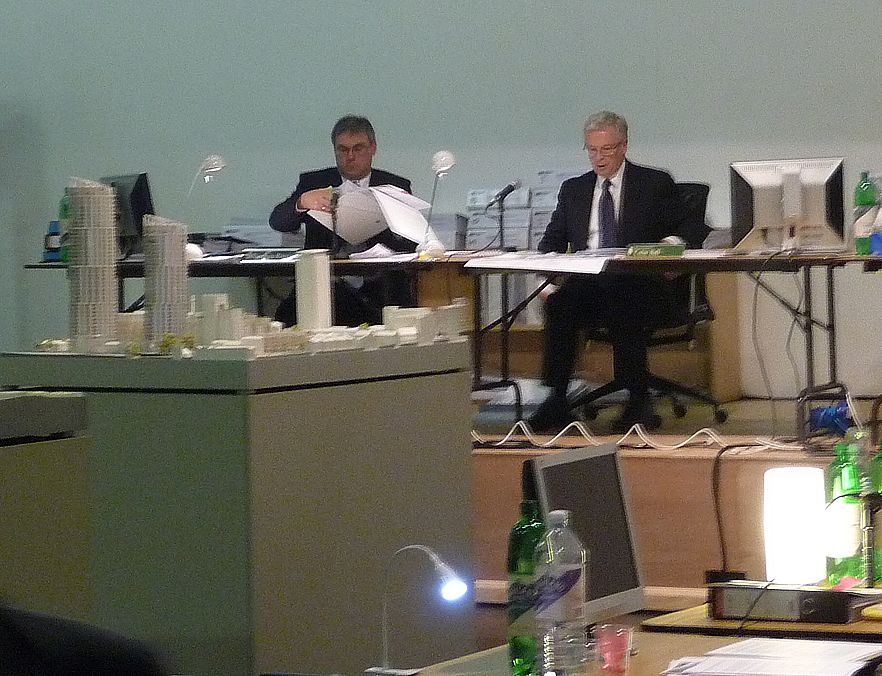
As I wrote on Thursday, the report of Colin Ball, the Inspector on the Ram Brewery Public Inquiry recommended that Application for erection of 2 towers at the northern end of the Ram Brewery site up to 32 and 42 storeys in height along with a number of additional middle size buildings in the site should be refused. The Secretary of State agrees with the Inspector’s conclusions, and agrees with his recommendation. It followed a month-long public inquiry last November, after the decision of Wandsworth Council was called-in on the request of the former local MP, Martin Linton.
I received the full report of the inspector: 214 pages. I will spare you comments on each single page, first because this article would become a novel size, and second because you should better enjoy the weather outside, the tennis/football this weekend and whatever other activity you might have chosen.
Supporting the analysis you will find here the reports:
I have decided to flip through the report of the Inspector to extract the considerations regarding the same points I raised in the CJAG evidence: tall buildings, transport, community benefits; beside I will also comment on the position on affordable housing and safety issue regarding the proximity of the gas holder that happened to be so controversial.
Tall buildings
A lot of time has been spent on the Applicant Visual Representations of the scheme. Criticisms have arisen on the quality of the images presented by the applicant. The Wandsworth Society has hired an independent expert and spent money on producing evidence on the real perception of the impact of the buildings. Despite the many attempt to discredit the work produced by the Wandsworth Society, the advocate representing Minerva (the applicant) lost the point as the inspector wrote clearly (p7):
“Guidance on how to prepare AVRs consistently indicates that images should ideally be made within a 40° field of view (FOV); beyond that, the perceived shapes of surrounding buildings may be distorted [...] the use of a wide angle lens has the effect of distorting perspective and distance, and thus the spatial relationship between foreground and background. Existing buildings, and therefore the new ones, appear further away or smaller than they are or would be in reality, This was particularly apparent to me when I compared the AVRs to the actual views from the same viewpoints and is also demonstrated in the Wandsworth Society’s comparable 40º AVRs.
[...] the applicant’s AVRs cannot be taken as accurately representing what would be seen by the human eye.“
You may recall that last year, along with the Wandsworth Society, the Putney Society and the Battersea Society we have submitted a joint statement on tall buildings where we specifically said:
“Appropriate publicity should be agreed with Council Members and officials at the pre-application stage and should use images which demonstrably reflect the true appearance, height and mass of the development measurable against neighbouring buildings.”
This was definitely not the case here for the Ram Brewery, as highlighted by the Inspector, and it was also a clear criticism of the twin towers proposal for Clapham Junction station where the same trick with wide angles was used by the developers.
Conservation area and the effect of tall buildings
Emerging policy provided by Wandsworth Council in its latest Site Specific Allocation Document indicates that Wandsworth town centre is appropriate for tall buildings. Indeed you have already the Sudbury House, a 23 storey residential tower block above the Southside shopping centre; 3 more recent tower blocks, of much the same height, have been built along the western edge of the shopping centre; another new tower block, of similar height, has recently been constructed at its southern end.
The SSAD says (p59):
“Here, buildings of 12 storeys and above will be considered against the DMPD tall buildings policy and buildings or more than 30 storeys will generally be considered inappropriate, and only considered in exceptional circumstances. [...] In December 2008, the Council resolved to grant planning permission for a development that includes 32 and 42-storey towers, which are considered exceptional in terms of design and their context and therefore acceptable.“
In presenting its case, the developers explained that the view from Wandsworth Park would be significantly enhanced by the ability to see two quality towers which will allow the park user to know and understand the position of the park in its wider London setting (probably because park users are so dumped that they need big marks to visualise where they go from far away! – sorry, I’m just joking here).
They also tried to argue that the visual impact of the towers would be limited because they would be so slender. In fact the plan dimensions of each tower – width and breadth – would be substantially greater than those of Sudbury House, itself a large block of fairly squat proportions. This is a clear illustration that any perception of slenderness would be simply a reflection of the fact that the towers would be so much higher. The towers would be very large buildings.
Here the Inspector starts by acknowledging that regrading the existing there is a justification for taller buildings in the area:
“It is therefore likely, and perhaps inevitable, that new buildings on sites within traditionally built areas of modest scale will be higher and more closely built-up. What matters is not so much the size and scale of new development but how well integrated it is into its surroundings in both functional and visual terms.“
However he cut sharp any hopes for the applicants, writing also:
“Here I consider that the huge differences in character, size, mass, scale and appearance are such that the contrast between the stable block and the towers would be particularly jarring. There seems to be no account taken of the specific character of the stable block or how that might influence the layout, and no designed relationship with the towers to successfully integrate it into the scheme, within an appropriate setting. [...] There would be a similarly jarring contrast as with the stable block between the tower blocks and the locally listed houses in Barchard Street to the east and the public houses and houses, including the listed Wentworth House, centred on Dormay Street to the west. There has been little consideration given to the impact of the development on these small-scale buildings, and there would be clear harm to the character and heritage of the area, in conflict with UDP Policy GEN6. [...] I consider that, at this northern end of the site, the development would have a poor relationship with the surrounding area. “
He added:
“It is vital the new buildings should fully respect the character and setting of the old, especially when they are of such outstanding interest. Here, as the AVRs show, not only would the characteristic skyline be lost but the new buildings, and particularly the towers, would utterly dominate the scene, changing the townscape character and undermining the quality of the setting of All Saints Church and Church Row.“
In addition the Inspector criticised the design itself, talking about the prominence in longer views, the rhythm on the façades which will confuse the perception of scale and the top of the towers which appears to be arbitrarily “sliced off”. Therefore he concluded:
“For these reasons I find the quality of design of the towers to be somewhat lacking.“
It is clearly demonstrated that most of the problem is created with the two huge towers. On the rest of the development, the Inspector considers that they would be appropriate to the town centre location and would be well integrated into their surroundings.
Public Transport
The CJAG, along with other opponents, was defending the case that Wandsworth station is already running over capacity, that trains are so crowded that passengers sometime prefer to catch a train in the opposite direction to get a chance to board on their train, and that alternative routes using Clapham Junction couldn’t be seriously envisaged as this station is already branded the second worst in the country.
However here the Inspector does not join our views as he wrote:
“At Wandsworth Town station, the existing and more critical am peak train loadings are high and, from the Assistant Inspector’s site visits, the data presented to the Inquiry is reflected in conditions at the station. The travelling conditions are however not unusual for inner London, and the trains only appear to be uncomfortably full for a relatively short period over the am peak and only for the early part of the journey into central London. [...] The increase would be sufficiently small to not be noticeable, and I consider that there would generally be sufficient capacity over the peak period to accommodate such an increase. “
Of course this is disappointing. In its visits, during a short period of time, the Inspectors have not seen what many people have complained about, and that was even recognised by the government when it named Clapham Junction (suggested as alternative use by the applicants) as one of the station in urgent need for investment. The explanation for this mis-perception might be read with the Inspector saying:
“Furthermore, there was no objection to these figures from the Council or the Mayor at the Inquiry. I therefore accept the figures put forward.” In its case, the developer actually said: “at Clapham Junction, most of the 40 trains to London in the am peak hour have passenger loadings below 80% and these are below 70% leaving Vauxhall to Waterloo“.
Maybe we should appoint our own study, but how and with which money? There is undoubted facts that the Council has however acknowledge the need for improving the rail stations in the area, with £300k allocated to CJ station Brighton Yard entrance and the announcement of £250k allocated to contribute to Wandsworth Town station refurbishment (but that was before the budget cut!).
Community Benefits
As the CJAG highlighted in its evidence, there was not much detail on the £41 million contribution that the developers were giving at the time the application was approved by the Council, except a vague consideration on the fact that most will be allocated to sort out the gyratory system. Actually, the Borough policy says that “buildings or more than 30 storeys will generally be considered inappropriate, and only considered in exceptional circumstances” (SSAD p59) ; the example of such circumstances is given of a significant infrastructure investment to solve current traffic issues. The Public Inquiry showed that the application was submitted in its current form without any such investment in mind – it was incorporated later – but no other exceptional circumstances were put forward with the application to justify such tall buildings.
Affordable Housing
As the CJAG also wrote in its evidence, for all new development (although depending on site circumstances) the expectation is a provision of between 33% and 50% affordable housing. In this scheme, the 11% total provision of affordable housing falls far short of even the lowest level of policy aim. The Inspector cannot do anything but say that it is therefore clear that the affordable housing provision that is proposed does not comply with the aims of LDF Policy IS5 or those of the London Plan.
But even more, he noticed that the level of affordable housing is concentrated exclusively in the Cockpen House site (on a different application), with none in the two huge towers. Therefore he commented that:
“There would be a complete lack of affordable housing on one site and an over-concentration at the other. [...] This would undermine national objectives to promote development that creates cohesive communities.“
And this is is main concern for the Inspector on this aspect. Although the Wandsworth borough is only 24% affordable housing (!), the town centre has a level of 42% (mainly due to the group of tower blocks in the estate behind Southside) and the proposal would change that proportion to 31%, still above the borough average (that will lower down too). We could argue noticing that that fact that Wandsworth is already a poor performer on affordable housing is not an excuse but we will keep his argument on mix communities and we agree with his conclusion saying:
“However, the concentration of all the affordable dwellings at the Cockpen House site, where they would form the majority of the development, could be socially divisive. What is more, the proportion of affordable dwellings, at just 11% of the total, is unacceptably low. I consider that there would not be an acceptable provision for affordable housing. [...] However, the applicant contends that this harm is outweighed by the benefits of the proposals, and is supported in this view by the Council and the Mayor. I consider the overall planning balance below but, in the terms of PPS3, [...] the proposal would not meet either London Plan or emerging local targets for the proportion of affordable housing to be provided. To that extent, I consider that the proposed development would not fully accord with national planning policy guidance in PPS3 Housing.“
Gasholder
The Inspector is a little bit bemused that the Stage 2 Urban Study makes no mention of this possible restriction in setting out the Opportunities and Constraints for Tall Buildings at the Ram Brewery/Capital Studios site and gives a strong indication that tall buildings should be located at the northern end of the site (also SSAD p59). Everything is displayed as there is no gasholder in the area or that no restriction has to be taken into account. He wrote:
“The proposed towers would be situated in the most sensitive part of the site in relation to the gasholder. [...] There is no evidence that safety has been a significant consideration which was taken into account in the design of the proposed development, and it therefore would conflict with paragraph 4.96 of the draft Core Strategy, to which I give significant weight” (but as shown above, to which the Council itself did not)
I will pass through the several pages talking about the probable risk (10 out of 1 million per year), the confidence level (90%), Scaled Risk Integral (which exceed the threshold by a factor of 18), HSE’s frequency analyses using the Poisson and the n+1 approach, the decision made for the development at Oval (the Inspector found this is of limited relevance). The Inspector concluded:
“The proposal would have a harmful effect on public safety with regard to the proximity of the Wandsworth gas holder, and that it would thus conflict with national policy on hazardous installations as set out in DETR Circular 4/2000 Planning Controls for Hazardous Substances.“
Overall the Inspector recommended only refusal of the Ram Brewery scheme including the towers, but allowed the demolition of other buildings in the area, and the application for the Cockpen House site (five buildings from 5 storeys stepping up to 10/16 storeys), although upon a series of conditions.
Secretary of State refuses planning permission for the Ram Brewery site
To summarize the Secretary of State decision:
- He considers that the proposed development would have an unacceptably harmful effect on the character and appearance of its surroundings, including important historic assets.
- He considers that the 11% affordable housing provision which is offered is unacceptably low.
- He considers that the public transport system would be able to cope with the extra demand placed on it by the proposed developments.
- He considers that the proposal would also conflict with national policy on hazardous installations.
- He does not want to comment on the gyratory system contribution as he finds it irrelevant in the context of the refusal.
Going further than the Inspector’s recommendation, the Secretary of State decided also that it “would be premature to grant conservation area consent for the demolition of the modern buildings on the site in the absence of any information about what shape future proposals might take” and therefore refused also planning application. However he agreed on the planning application for Cockpen House. Considering the fact that this application was deeply linked with the tower scheme (especially in term of affordable housing) he decided to grant permission subject to conditions and to submission to a new s106 agreement. He has given 6 weeks for the applicants to do so (followed by a 2 weeks consultation period). He will issue a final decision by the end of September on this latest application.
And now?
Despite his refusal of the proposal, the inspector encouraged the Council to pursue its effort to redevelop this part of the Wandsworth, saying (p6 of the conclusions):
“Both sites can be fairly described as under-used, town centre brownfield land. As such they should be a priority for redevelopment. They are effectively the only available sites within the town centre which can provide a significant opportunity for regeneration. The inquiry showed widespread public support in principle for the proposed mixed-use redevelopment of the sites, with universal approval of the retention and re-use of the brewery buildings.“
The Inspector gave also his views in the development of the town centre, saying:
“In my view, the density of residential use is not the only, or necessarily the best, indication as to whether a development maximises the potential of a site, especially in a mixed use scheme. The contribution of the retail, leisure and commercial elements of the scheme to the vitality and viability of the town centre, including the reuse of important historic buildings, is equally important. This is crucially a matter of balance, with the aim of achieving the maximum intensity of use compatible with local context. [...]
I consider that in principle the Ram Brewery site would be a suitable location for tall buildings in general accordance with the locational criteria of Policy 4B.9. [But overall] the proposals would not meet the pivotal criteria requiring high quality design and respect for local context.“
In presenting its case to the Inquiry, the Council considered that the benefits of the proposed schemes were overwhelming, and far outweigh any negative aspects relied upon by the opponents of the scheme.
After one of the biggest public inquiry organised for a planning application in London, the Secretary of State has joined the Inspector who agrees on most of the claims raised by the Wandsworth Society along with other interested parties. It’s time to go back to the “drawing board” and pay better attention to the local resident views, as it shows here that contrary to the Council they were right to oppose this application.
According to the article published by Wandsworth Guardian, Minerva’s chief executive, Salmaan Hasan, said:
“We are naturally disappointed by the Secretary of State’s decision and remain committed to our Ram Brewery and Buckhold Road sites, which represent a rare opportunity to regenerate Wandsworth town centre. However, the Secretary of State has given a positive response to many aspects of the scheme and given guidance as to what is likely to be acceptable. We will now consider the information and guidance in the Secretary of State’s response and review our options as we look to move the scheme forward.“
Indeed any new plan will be scrutinised in view of the report produced by this Inquiry.
It is always dangerous to use radical slogans, as it could backfire. The Council presented the redevelopment of the site as a “once in a lifetime opportunity“. It has now to work to prove its statement wrong and deliver a better plan for the regeneration of the town centre within the next… 80 years? Even if the people who fought this plan have the right to crow, I have no doubt that their priority will be to work with the Council to make Wandsworth Town a better place for everyone.
Forthbridge school site campaign takes first step
>> Your chance to contribute: tell us what your think on Clapham Junction station redevelopment
Last night Wandsworth Council’s Education Overview Committee received its first Deputation in over five years.
We are very pleased that the 469 objections made to using the Forthbridge Rd school site simply as an expansion site for the Belleville School have been properly heard.
Part of the proposal is that the admission distance will still be set from the Belleville School site over 1km away. As Belleville is such a large and oversubscribed school, the Forthbridge Rd site will still be well outside Belleville’s catchment area. This means children local to the Forthbridge Rd site will have no hope of accessing the school on their doorstep.
Rachel Casstles spoke eloquently on behalf of the objectors to the committee, emphasising the support for schools in the area, but to exclude local children was felt by many to be very unfair. (Plans are for the site to be run like a separate school with one form entry per year, making it so much more than an “annexe” for Belleville school which itself changed its mind on a plan for on-site expansion last year).
She also presented our argument that actual demand for school places in the area near the site is assessed inaccurately and is underestimated by the Council (demand for places at the much closer and successful Wix school have rocketed in 2010, but it was never even offered the site).
Local area councillor Guy Senior spoke about the strength of feeling in the area and his Shaftesbury Ward colleague Jonathan Cook spoke about this “an undesirable situation” and his concerns for a school “isolated from its catchment and local community.”
Many questions were addressed to both the deputation and the Children’s Services Assistant Director Adrian Butler by other interested members of the committee.
Sadly the committee voted through the recommendations to be approved by the Council’s Executive Committee on Mon 5th July.
As well as approving the expansion these recommendations include a future consultation exercise on the admission arrangements for Alderbrook, Honeywell and Belleville (including the Forthbridge Road site) and Wix School.
We learned this consultation will happen in this Autumn and its results could affect admissions from 2012.
As the Forthbridge Road site is specifically mentioned we are very much hoping to influence the terms of that part of the future consultation. We feel we have a strong mandate to do so and see this as the start of our campaign to gain fair access for local children to the site.
Thank you all for your continued support
Ram Brewery: towers refused by government
>> Your chance to contribute: tell us what your think on Clapham Junction station redevelopment
Author: Cyril Richert
We have just received the decision of the Secretary of State regarding the Ram Brewery redevelopment plan Inquiry.
I will just copy below the main decision regarding the scheme with skyscrapers and will develop some analysis later (as soon as I have time this weekend).
Application A:
erection of 8 new buildings comprised of 2 towers at the northern end of the Ram Brewery site up to 32 and 42 storeys in height with retained listed stable block and new 3-storey building fronting Armoury Way; 2-9 storey buildings consisting of 4 residential blocks above first/second floor level… etcThe Inspector recommended that Application A should be refused. For the reasons given below, the Secretary of State agrees with the Inspector’s conclusions, and agrees with his recommendation.
Link to the report of the inspector


Recent Comments