

Archive for November, 2010
Question in Parliament: no commitment for Clapham Junction station
Author: Cyril Richert
On Thursday 25 November the Oral Answers to Questions on Rail Investisment in the House of Commons gave Jane Ellison the opportunity to ask about the funding for Clapham Junction station.
Jane Ellison (Battersea) (Con): I very much welcome the Secretary of State’s statement, and the fact that stations were not overlooked. Clapham Junction in my constituency is one of the two busiest interchanges in the country. To make the railways really work, we need great modern interchanges. Although Clapham Junction never made it in any of the three previous control periods, will he join me in hoping that it will be closely considered by Network Rail for the next control period?
Mr Hammond: Network Rail is considering the section of line from Clapham Junction into Waterloo, and I will discuss its plans with it over the coming months and years. My hon. Friend might like to know that I have been told this morning that when the work at Farringdon is completed, Farringdon will overtake Clapham Junction in terms of train movements.
During our meetings with rail officers (Office of Rail Regulation) at the beginning of the year, we were explained the next funding process starting in 2010 such as:
- 2010: the industry will come with options (definition of projects and allocations).
- 2011: the government will examine a draft proposal.
- July 2012: the government will provide new specifications.
- 2013: ORR will review, analyse and check the funding for 2014-2019 (CP5).
- 2014: project implementation for CP5.
In addition, the Secretary of State should read cjag.org (or maybe Jane Ellison can give him the link). Instead of learning just on the morning of the debate that Farrington station would take the role of busiest station in Britain from Clapham Junction, he would have read 3 months ago that his colleague Transport Minister Theresa Villiers said :
“This important work at Farringdon will see the station transformed into a 21st century transport hub [...] set to become the busiest in Britain.”
Is this additional statment from Mr Hammond a hint to explain that there is no need anymore to fund Clapham Junction station?
The Clapham Junction Action Group is committed to work with residents, political parties, businesses and all stakeholders to provide ideas for the redevelopment of the station. You can participate here (click).
Library services in budget review: York library to close in Latchmere?
Author: Cyril Richert
At the beginning of November, the Council published a note stating that in view of the budget review they needed to consider cuts in the libraries budget.
They are considering 2 options:
- The closure of the borough’s six smaller neighbourhood libraries (saving £1.2m a year in running costs ) with the local residents forced to use the remaining five main town centre libraries (75% of all visits).
- All the borough’s libraries operating reduced hours accompanied by the only closure of York Gardens (in the Labour ward of Latchmere).
Councillors on the environment, culture and community safety scrutiny committee discussed the changes at their meeting on November 15.
The Conservatives councillors all approved the proposals.
“Agreed (by 6 votes to 2) that the recommendations in paragraph 3 of the report be supported subject to the addition of the following wording to recommendation (b): “it being noted that the review had excluded the closure of other neighbourhood libraries;”.“
However, confronted to the Latchmere councillors (Labour) who all spoke against the proposals, the final decision included:
“that no further consideration be given to the closure of the York Gardens Library, until full analysis has been obtained of the footfall at the Library, including numbers attending to access books whilst on the premises and to access the other services provided in the library, such as use of the ICT suite, the Job Club and the Homework Club;“
The need of further investigation appeared after Cllrs Belton, Hogg and Speck addressed the Committee arguing against the inclusion of the closure in the York Gardens in the consultation on the savings options, asked to investigated data on new people in the area and referred to two petitions that had been received opposing the closure of York Gardens Library which would be presented to Council.
Reading through the report by the Director of Leisure and Amenity Services, the Option 2 (proposals for reducing opening hours) could be decided while maintaining the York Garden library (saving £422,000 in 2011/12 and £563,000 if York Gardens library closed rather than be subject to reduced hours).
Regarding the cost per visitor/user the report says:
“It is difficult to make completely accurate comparisons [between the libraries] as, for example; the three neighbourhood libraries each have some form of additional facility such as a hall or IT Centre, and Battersea Library houses the Reference and Heritage sections.“
The report makes also interesting reading:
- York Garden has the highest number of people living within the one mile catchment area of the library (81,466).
- Wandsworth is 4th highest population per library in London (only beaten by Lambeth, Hammersmith & Fulham, and Kensington & Chelsea). [However it does not prevent the Director of Leisure and Amenity Services to write that "Wandsworth, for historical reasons, is generously covered by library provision" and that "five town centre libraries, of high quality, would be sufficient". It would make Wandsworth the worst borough of London in term of population per library!]
- York Gardens has a hall for hire to the local community: that functionality would disappear if the library closes as there is no plan to replace it.
- York Gardens has a high percentage of Children’s book loan (50%).
- Latchmere Ward is ranked as the most deprived ward in the Borough.
- Local people would consequently be harder hit by any reduction in access to IT facilities, as currently offered by the library
With all those arguments, you can guess the position of Wandsworth Council. To retain the library? Environment and culture spokesman Cllr McDermott said:
“My own view is that given the difficult financial circumstances we face the option I favour would be to reduce opening hours and close the branch at York Road, but it will be up to my colleagues and members of the public to determine which choice is finally made.“
Despite the very negative comments from Conservatives councillors (keen to close a library in a Labour Ward?) the decision can still be overturned. In the past three days, more than 500 residents have signed petitions to keep the library open and collection continues. You can download the petition HERE and return it by FREE POST.
A Save York Gardens public meeting will be organised for 2pm on Sunday, December 5 at the Library (click on the image below to see bigger).
Councillors in Latchmere are also encouraging residents to write to the council to expres their unhappiness with the decision.
Petition to object the Council’s plan for Belleville’s extension
Following the primary school consultation and the Public Meeting at Belleville School, Monday 15Nov10, a petition is available online aiming to “object to Wandsworth Council’s flawed proposals for the Forthbridge Rd school site“.
Author: Ian Hamilton
After an expansion consultation in June 2010, Belleville Primary School will use the Forthbridge Rd school site from Sep2011, but admissions will still be based on distance from the Belleville main site, over a 1km away.
Wandsworth Council passed this plan despite the 479 objections it received. These were made mostly to the admissions policy which will exclude local children from the Forthbridge Rd site.
Wandsworth Council are now holding another consultation which ends very soon (1st Dec2010).
We, the undersigned, believe that:
- The Wandsworth Council proposals detailed in the latest consultation are flawed and do not adequately address any of the concerns of the 479 objections made in the Belleville expansion consultation (June2010).
- These complicated proposals for two, ranked Geographical Priority Areas have conflated the sibling issue at Belleville with the Forthbridge Rd school access issue.
- The proposal for a Second GPA which:
a) is ranked in priority behind the First GPA;
b) contains the Forthbridge Rd site, but is skewed to the west of it;
c) still calculates admission distances from the main Belleville site;
means there is little realistic chance of any child living close to the Forthbridge Rd site gaining access to it.
(As acknowledged by the council at the public meeting on 15Nov2010).
Instead we would urge Wandsworth Council to recognise that:
- The Forthbridge Rd school site is an opportunity to develop a successful school site with a strong link to its local community, rather than simply an isolated annexe;
- This would best be achieved by a guaranteed percentage of the reception places at the Forthbridge Rd school site being reserved for local children;
- Admission criteria for this to be the same as any other school site BUT distance to be measured from the Forthbridge school site;
- These local places could be phased-in over a number of years starting from 2012 (to protect demand at other local schools north of the Clapham Common);
You can respond to the consultation before 1st Dec in writing to The Consultation Officer, Admission Consultation, Room 90, Town Hall, Wandsworth High Street, London SW18 2PU
Or Email primaryexpansionconsultation@wandsworth.gov.uk
Or online www.wandsworth.gov.uk/bsf/consultations
Online petition to object to Wandsworth Council’s proposals for the Forthbridge Rd school site (CLICK HERE)
Read also:
Notes on Public Meeting at Belleville School, Monday 15Nov10
Author: Ian Hamilton
The meeting was chaired by Cllr Kathy Tracey and started with a presentation from Assistant Director of Education Sarah Harty and then Q&A from the floor.
Around 100people, chiefly from three groups – who were mostly opposed to the proposals: Belleville Governors, Northside residents and residents from south of Broomwood Rd.
Other than Parent Governors I believe a fair observation is on the low turnout of “regular” Belleville parents (though the 2017 exception means these plans will not actually affect them).
Some facts came to light from questions on the council map of 2010 reception places allocated at Belleville.
We have asked for the date of this map to be clarified and if it may be posted on the council website.
- 5 non-siblings inside the second GPA got reception places in 2010 at Belleville
- In their proposal letter the council said 25 siblings were made offers who would not have got in on distance alone, at the meeting a related point was made that 19 siblings who live outside both GPAs gained reception places in 2010 at Belleville. Not quite all siblings are marked on the map (as some are from even further than the scale of the map). Counting pink stars it seems maybe only 1 sibling place is not on the map.
- In addition there were 6 siblings in the second GPA
Belleville Governors said they are supportive of siblings attending the same school and were very concerned about the impact on filling in-year vacancies (they fear families won’t take an in-year place if future siblings not allowed).
They argued that Belleville tries harder than most schools to fill these vacancies (but like all schools has some e.g. in year6 the Head informed the meeting). They feel this is important way to increase the school’s diversity.
The Governors are concerned Belleville is being singled-out for sibling rule changes. Here is their newsletter.
South of Broomwood Rd residents who would now fall outside the southern boundary of the proposed first GPA argued that some places do currently go to south of this line.
Sarah Harty stated that actually no 2010 non-sibling reception places were actually offered south of Broomwood Rd but the map presented has one marked and two on Broomwood Rd itself (hence the need for clarifications above).
Under the new proposals these residents will now definitely have much less chance of getting into Belleville and they expressed doubts that the Alderbrook expansion will reach up high enough to include them.
It was clarified that Honeywell, a Foundation school is in charge of its own admission policy. It plans to consult next spring (at least two people suggested any admission changes needed to be coordinated amongst schools in the area).
Several Northside residents spoke against the current idea, stating that the new proposals do not address any of the concerns of residents near to the Forthbridge Rd site. A flyer was distributed at the start of the meeting by some (download HERE).
It was asked why the distance calculation in the second GPA was still from the Belleville main site and why the idea of a percentage local entry (as suggested by Cllr Kathy Tracy herself at the July Education Committee meeting!) was not part of the proposals. Both questions drew no response from the council.
The example of Henry Cavendish School, 2miles away in Lambeth was introduced – it recently expanded to two sites and calculates distance from either site. The Council seemed unaware of this school and declined to comment further.
Concerns about increased traffic were mentioned by one Marmion Rd resident.
The council stated there were only 9 applications to Wandsworth schools this year from the streets immediately surrounding the Forthbridge Rd site.
The council perception of future demand was attacked and someone asked about the contradiction of even designing a second GPA for an area with no alleged demand.
A questioner asked about Beatrix Potter School, the only other Wandsworth School with two ranked GPAs, pointing out that several recent years had seen no non-siblings from the second GPA gain a place there.
Bruce Glocking from the council actually agreed that the chances of any child living near Forthbridge Rd site gaining access to it were realistically very small!
Two residents spoke in support of Wix School on the Northside.
Read our article on Belleville and Alderbrook: primary school consultation
Public Consultation on planning strategy document (SSAD)
Author: Cyril Richert
The planning inspectorate has now confirmed that the WBC planning strategy is sound and can go ahead with a number of amendments. Most of the changes were discussed at the public hearings in February 2010 and you can read our comment on the Inspector’s approval here. The Council has officially adopted the final version of the Core Strategy in its meeting in October.
The Proposed Submission versions of the DMPD (Development Management Policies Document) and SSAD (Site Specific Allocation Document), which provide detailed policies to support the delivery of the Core Strategy, are now proposed for public consultation up to the 10th December 2010.
We have already submitted comments in the previous consultation on the Site Specific Allocation Document in February 2010 (download in full HERE and article HERE). We are concerned that, with the length, volume and complexity of the documents it is very difficult, if not impossible for the general public to make a fair participation to the consultation. As highlighted also by other amenities societies, the Council should explain the changes made in the documents and why some suggestions for amendments were not implemented.
Below is an extract of the full submission, concentrating on comments on the Clapham Junction area. You can download the full submission HERE (pdf).
Proposed amendments regarding Clapham Junction SW11 (p109-118 of the SSAD):
For clarity we kept the same numbers for sections as in the SSAD document and highlighted our proposed changes in grey background.
4.1 Planning Policy Content: the case for tall buildings – page 109
The Core Strategy was amended to remove some of the specific references to tall building in Clapham Junction area, following the Inspector’s concerns that the current policy did not include specific reference to account being taken of the historic context when assessing applications for tall buildings.
Thus, PL13 clause b) was amended to add (amendment in bold):
Taller buildings could not only help deliver significant regeneration benefits but also give a visual focus to the town centre, subject to the qualifications set out in Policy IS3 and the criteria based policy on tall buildings to be included in the Development Management Policies Document.
Clause e) was also changed to remove (amendment in bold):
Taller buildings in this location could be justified due to the proximity of Clapham Junction station and its accessibility to high frequency public transport.
But the Council decided to keep the wording:
Taller buildings could not only help deliver significant regeneration benefits but also give a visual focus to the town centre, subject to qualifications set out in Policy IS3 and the criteria based policy on tall buildings to be included in the Development Management Policies Document.
However, in the main conclusions of her report , the government inspector wrote clearly:
1.7 My overall conclusion is that the London Borough of Wandsworth Core Strategy DPD is sound, provided it is changed in the ways specified in Annex A. The principal changes required are, in summary:
[…]
d) To amend policies relating to the locations where tall buildings may be acceptable (Policies IS 3, PL 11, PL 12, PL 13, PL 14) to reflect the Council’s Stage 1 Urban Design Statement and to acknowledge the ongoing work in the Stage 2 Urban Design Statement and lower level DPDs.
We look at the Council’s Urban Design Statement (S2UDS) and we can read page 26 (we put in bold):
2.34 [...] Accordingly any building of five storeys and above would be noticeable above the prevailing height within the town centre. Because of the need to protect the essential character of the buildings that define the main shopping streets, applications for development of 5 storeys and above will be subject to the criteria of the tall buildings policy contained in this document.
In a similar way we open the DMPD document and we can read page 22:
2.44 [...] The Core Strategy also acknowledged that there will be some sites within these locations that are sensitive to, or inappropriate for tall buildings, and that outside these areas tall buildings are likely to be inappropriate.
We are a bit surprised to see that there is no amendment to the Core Strategy Policy PL13 , although Policy IS3 states that c) tall buildings should not harm the character of the surrounding area and d) some locations within these areas will be sensitive to, or inappropriate for, tall buildings.
On page 109 of the SSAD there is mention of the Core Strategy Policy PL13 with the comment above. The meaning of this sentence is still nothing less than an encouragement to develop taller building in Clapham Junction area, while this has already been the subject of lengthy discussion during the Local Development Framework consultations.
Although there is a reference to the UDS and the DMPD, there is no clear mention of the sensitivity of the site in this global presentation (page 109). This is especially misleading when put in perspective with statements in the following pages 110-118) stating either:
- the site is sensitive to tall buildings, and the height at which a development in this location will be considered to be tall is 5 storeys.
- tall buildings in this location are likely to be inappropriate
Therefore the page should be amended to clearly state (in accordance to the Inspector’s requirement) that :
- The centre has a rich historic heritage and as such is considered sensitive to tall buildings (see map below).
- Because of the need to protect the essential character of the buildings that define the main shopping streets, applications for development of 5 storeys and above will be subject to the criteria of the tall buildings policy contained in this document.
In addition, we consider strongly that to measure the height of buildings by storey heights is unsound as these can vary considerably (8 storey approved for Falcon Road is the same size as PCS 4-storey building). Actual heights (meters) should be stated in all the document.
All pages should be amended to read, for example:
the site is sensitive to tall buildings, and the height at which a development in this location will be considered to be tall is 15 meters.
4.1.1 Asda, Lidl, Boots and 155 Falcon Lane, SW11 – page 110
Streets: A specific attention has been made to the piece of land between the residential houses (Mossbury road) and Falcon Road.
Pages 106 of the SSAD document it says:
Given the restricted nature of land on the south side of Falcon lane it is suggested that it could be re-aligned slightly to the north to allow frontage mixed use development with retail provision to the ground floor.
It doesn’t really seem to have considered some of the fundamental issues or the effects on existing properties either side of it.
As presented, the project is in complete contradiction with the Core Strategy encouraging the development of public realm and the provision of retail floorspace .
The current vision will involve the move of the current Boots and the loss of Lidl and the car park. Although it could be envisaged in theory, there is no consideration on feasibility and cost (who is funding what): the land to the north will dramatically be reduced in size and value, rendering the scope of future investment there questionable at best.
In addition frontage and main residential windows of any development proposed will be forced to face north and directly looking upwards at a railway embankment.
Is the south side of Falcon Lane a suitable site for future residential development? The rear gardens of the houses in Mossbury Road are already tiny. Any reasonable view will concede only two realistic solutions:
- to offer extension of existing properties by land purchase
- to redevelop the open area with public space/square.
Tall buildings: The site is sloping down from Lavender Hill to Falcon road. The impact of a 5 storey building at the bottom won’t be the same as for a similar height at the top, where current buildings do not exceed 3-4 storeys.
4.1.2 Lanner and Griffon House, Winstanley Road, SW11 – page 112
Tall Building: Here it is worth quoting the full paragraph:
In accordance with Core Strategy Policy IS3d, tall buildings in this location are likely to be inappropriate. In accordance with DMPD Policy DMS4, the height at which a development in this location will be considered to be tall is 5 storeys.
Readers should appreciate that this policy is already in contradiction with the approval by the Council of the redevelopment of the site along Grant Road (Griffon House & Lanner House 6 Grant Road SW11) involving demolition of existing buildings and construction of two new buildings up to 11 storeys (without reference to the DMPD policies on tall buildings) to provide 452 self-contained studio rooms for use as student accommodation. In addition it was reinforced in September 2010 with a new application granted for an additional 6 storey building to provide 114 self-contained studio rooms.
Therefore the whole area is currently under construction with 3 buildings/high density up to 11 storeys and – except considering that this investment has any chance to be knocked down within the next 15 years – a full rewriting of the page in view of the current situation needs to be carried out, including changing the title of the section as Lanner and Griffon Houses do no longer exist.
4.1.3 Car park adjacent to Sendall Court, Grant Road, SW11 – page 113
Site Allocation: the document says:
Entirely residential, or a mixed use development with commercial use on the ground floor and residential accommodation to upper floors.
However on the previous page, Lanner and Griffon House, Winstanley Road, SW11 – page 112, the Nature Conservation statement says that the site is located within an area of deficiency in access to nature.
In addition, the visual representations provided by Berkeley first for their redevelopment of Lanner and Griffon House always presented an open space, used for public space, and balancing the very high density of their proposal.
In view of the adjacent developments already authorised and in excess of the guidelines provided in this same document, the site allocation should be reserved for public realm use only, such a square and public space.
4.1.4 Clapham Junction Station Approach, SW11 – page 114
We acknowledge the mention of the site being sensitive to tall buildings.
We agree on the justification providing that the site offers a real opportunity to provide the type of retail unit suited to the larger chain stores.
However the current presentation (including page 109) is actually re-using some of the planning of Delancey’s proposal without addressing the much needed issue of circulation between the two sides of the railway (Grant Road vs St John’s Hill).
The proposal map could be amended to present:
Current map (#64) vs Proposed presentation, including open path and a much larger coverage of the railway allowing better retail usage.
4.1.6 Land at Clapham Junction station, SW11 – page 117
The site allocation is for residential and safeguarding for transport use (Core Strategy an London Plan requirement). However we suggest that this paragraph should be amended to read:
Mixed use development to capitalise on the existing excellent rail connections into and out of London which will be improved even further by the East London Line extension and encourage one or more major employers to base themselves in this Town Centre; other appropriate uses include business, hotel, cultural, leisure and entertainment. Transport use should be safeguarded (Core Strategy Policy PL3).
4.1.7 Peabody Estate, St Johns Hill, SW11 – page 118
There is a small change in the guidelines for tall building between the SSAD published on the 27 Nov 2009 and the current proposed submission.
The SSAD 27/11/09 said:
Tall buildings: In accordance with Council’s Stage 2 Urban Design Study – Tall Buildings, applications for buildings of 5 or more storeys will be subject to the criteria of the tall buildings policy contained in the emerging DMPD. In accordance with Core Strategy policy IS3d, tall buildings in this location are likely to be inappropriate.
The current proposed SSAD says:
Tall buildings: In accordance with Council’s Stage 2 Urban Design Study – Tall Buildings, applications for buildings of 5 or more storeys will be subject to the criteria of the tall buildings policy contained in DMPD Policy DMS4. The part of the site within the town centre is identified as being sensitive to tall buildings, whilst on the southern part of the site adjacent to Wandsworth Common they are likely to be inappropriate, in accordance with Core Strategy Policy IS5d
You will appreciate that the previous part that we highlighted in bold, stating that tall building in this location are likely to be inappropriate (CS IS3d) has been removed and replace with only a mention of the southern part of the site, the remaining becoming only “sensitive”.
The fact that the Council cannot ignore is that Peabody Trust is currently working on the possible redevelopment of the estate, including knocking down the existing buildings and replacing them by high density constructions including a 21-storey tower, along with a 13-storey and 10-storey buildings.
The re-wording seems an attempt to address the arguments raised by developers to ease their planning: in the new version, their taller buildings will be located in the sensitive but no longer inappropriate location! It is noticeable that the paragraph does not mention anymore the Core Strategy IS3 talking about the impact on the surrounding area. Located at the top of the hill, a 21 storey building will appear to be about 28 storeys when viewed from Arding and Hobbs and will nearly double the size of the estate in Grant Road.
We consider the boundary change in the DMPD to be an attempt to justify the inclusion of part of the estate in the “sensitive but not inappropriate to tall building” area for town centres, rather than the promotion of the St John’s Hill frontage.
Therefore the tall building criteria should be changed to:
Tall buildings: In accordance with Core Strategy policy IS3c&d, tall buildings in this location are likely to be inappropriate.
The Clapham Junction Action Group wishes to participate at the oral examination
It is important the arguments set out above are presented and developed during discussion of policy on Site Specific Allocation.
|
Current map (#64) |
Proposed presentation, including open path and a much larger coverage of the railway allowing better retail usage. |
Analysis of the proposed DMPD – planning policy document
The planning inspectorate has now confirmed that the WBC planning strategy is sound and can go ahead with a number of amendments. Most of the changes were discussed at the public hearings in February 2010 and you can read our comment on the Inspector’s approval here. The Council has officially adopted the final version of the Core Strategy in its meeting in October.
The Proposed Submission versions of the DMPD (Development Management Policies Document) and SSAD (Site Specific Allocation Document), which provide detailed policies to support the delivery of the Core Strategy, are now proposed for public consultation up to the 11th December 2010.
Patricia Poulter (a member of the Putney Society) sent us her analysis of the proposed DMPD document and highlighted changes that should be implemented. We have highlighted in bold green the comments that are also made in the submission from the Clapham Junction Action Group.
Author: Patricia Poulter
Response to the consultation on DMPD and SSAD proposed version 2
Consultation:
As experienced in the previous submission, the consultation documents are extremely lengthy and whilst a great deal of effort has gone into making them more comprehensible to the general public their sheer volume and complexity will deter a lot of residents from participating.
Changes made:
A number of changes have been made to the DMPD and SSAD versions compared to the earlier submission. These changes have not been explained within the documents as responding to any comment or request from either the Inspector, the residents, developers or amenities groups. It would have been very useful to know the reasons behind the alterations. It is stated that some amendments were made to avoid repetitions. The changes highlighted in the attached document do not fall in that category.
Tall buildings:
It is generally perceived that it would benefit all interested parties if the definition of “storeys” was also qualified in meters on planning applications leaving no room for misunderstandings. It is also thought that planning applications subject to tall buildings policies should clearly display the height in meters of adjoining buildings in their design and access statements as well as their plans.
The removal of the “buildings beyond x storeys will be unacceptable”( referred to by residents as maximum heights) has now been replaced by alternate wording that implies that intensive high rise development is acceptable. This is disappointing.
It is also clear, based on current applications coming through on the Upper Richmond Road, that the maximum heights quoted in the earlier submissions have been viewed by developers as acceptable heights. This is confirmed by the current applications for Tileman site and Tote.
The damage has been done! Applications are coming through seeking to double the heights of existing buildings. This is contrary to the Council Leader’s pre election pledge that buildings on the Upper Richmond Road should be replaced with buildings similar in scale to the existing ones.
Crime and disorder:
The issue of law and order in the proposed private public realms still has not been addressed in depth in this new version of the DMPD and is of serious concern to all residents.
Financial contributions from developers:
There seems to a tendency to seek contributions from developers for infrastructure and transport enhancements. This needs a great deal more transparency. Whilst it is probable that a substantial amount of the monies collected will go to improve the infrastructure where these developments will take place, it is important that these contributions are detailed at application stage and more visible to the public.
The Council must be seen to make realistic requests from developers for projects that have a clear implementation date and over which they have complete control. Collecting contributions from developers for improved train capacity for example is not within the developer’s nor the Council’s control.
Local distinctiveness:
The emphasis on local distinctiveness prominent in the previous submission has been removed from this new version, including the adherence to setbacks typical of the area where developments are proposed. This is a retrograde step.
Town Centres:
The changes that seek to reduce the percentage of A1 retail in secondary shopping frontages will result in loss of amenity for communities. Residents require to retain in their vicinity shops that serve the needs of the local community.
The Town Centre boundary change on the Capsticks site is based on the disingenuous statement that it is only a small part of the site. It actually represents more than two thirds of the site. This is unacceptable. It is the slippery slope to creating shopping frontages in residential streets. It is difficult enough the main core shopping parades fully occupied, it seems ill advised to encroach on residential boundaries. This should not be allowed.
Treatment of neighbours:
It is disappointing that neighbours of sites identified in the SSAD are treated unequally.
There is already sufficient bias towards residents in conservation areas who are well protected by conservation regulations.
There is however an inherent unequal treatment of neighbours of sites outside conservation areas. This is undemocratic, unjustified and assumes there are various classes of citizens. All residents deserve equal protection from harmful development.
Wandsworth Living Streets: feedback on the meeting
Author: Cyril Richert
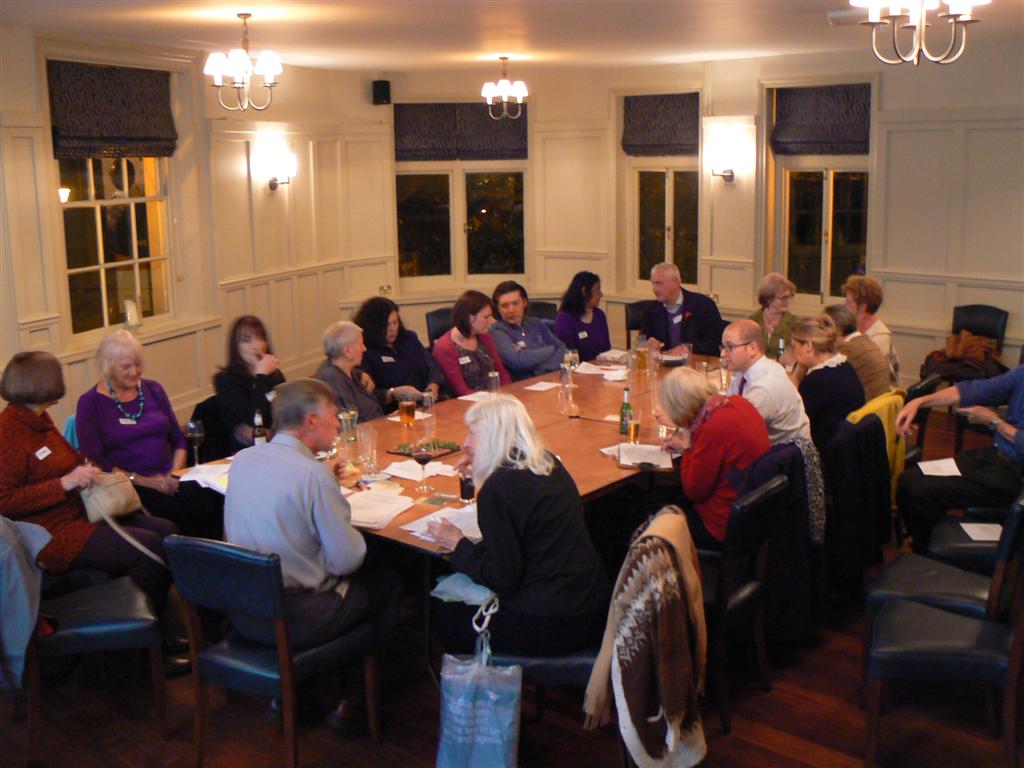
Last Monday (8th November 2010) was organised the Launch Meeting of the Wandsworth Living Streets. Susie Morrow and Robert Molteno were chairing a very well attended reunion (there was not enough place around the huge table) in the upstairs function room at The Alma Pub. Amongst the crowd were Councillor Russell King (Conservative, Balham – Chair of Transport Committee) and Councillor Leonie Cooper (Labour, Furzedown).
Why set up a Wandsworth Living Streets group?
The Mayor of London has announced that 2011 will be London’s Year of Walking. We feel it’s timely to establish a local Living Streets group, to work towards safe, attractive and enjoyable streets in our borough…. which means wider pavements, better crossings, comfortable places to sit down, streets that everyone can use, a convivial public realm, quieter and more peaceful roads, cleaner air….
Below are my observations (as for the Planning Forums I attended). In dark red are some personal comments.
Introduction to Living Street
Susie Morrow presented the national charity (www.livingstreets.org.uk) launched 81 years ago (a pedestrian association at that time). They helped to introduce highway code, speedometers in cars, pedestrian crossing, driving test…. Susie introduced a series of photographs showing the kind of issues we face and gave example of other big cities (e.g. New York) where radical move to public space have been implemented.
Local Issues Wandsworth Living Streets might campaign on
Discussions were then focusing on specific issues that Wandsworth Living Street might focus on, introduced by Robert Molteno.
Transport for London’s proposed removal of eight pedestrian crossings across Wandsworth
125 signals across London have been highlighted for potential removal, and 8 are in the borough of Wandsworth (Plough Road by Maysoule Road, the Avenue by Broomwood road,…). We were wondering why – as thy were needed 5 years ago – they are not needed nowadays and discussions within the group (along with feedback from the Council) lead to the idea that the job was probably done by someone not knowing the area.
This is just an initial consultation and there is no indication of what replacement has been considered: zebra crossing? nothing?
Living Street has already asked justification for each location targeted for removal under the freedom for information act.
20mph speed limit in residential and local shopping streets
A lot of cities are already ruling 30mph out and implementing 20mph (Oxford being one of them). It was suggested to the Council to set up working groups with all stakeholders (amenities societies, resident associations, councillors, officers, partnerships,…) to list possible locations to reduce speed limit. It did not raise a massive enthusiasm apparently by answer was that it could be considered within… 6 months.
CJAG raised the topics of the Exemplar Scheme, road works currently happening in the Clapham Junction area. The Strategic Planning and Transportation Overview and Scrutiny Committee approved the scheme during its meeting on the 20th September, 2010. However all of the points raised by the Cycling Campaign to reduced the speed and implement safer roads were turned down, including suggestions such the one I raised in our article (a ‘default’ 20mph speed limit in Falcon lane, a raised table, enlarging the pavement or 20mph in St John’s Road).
Cllr King said that it was too early for Clapham Junction and the Council is currently only taking a one dimensional view. However they were keen on having a second look later and further improvements could happen at another stage (a two dimension? or should we suggest a three dimension maybe?). Cllr Cooper asked if the Council could move beyond the one dimensional view.
Making our Town Centres more people-friendly
Sue Roscoe Watts, chair of the Wandsworth Town Centre Partnership said they would welcome any idea and speaker at their meeting to present suggestion on what could be done.
Contributing to Wandsworth Local Implementation Plan
The planning inspectorate has now confirmed that the WBC planning strategy is sound and can go ahead with a number of amendments. Most of the changes were discussed at the public hearings in February 2010 and you can read our comment on the Inspector’s approval here. The Council has officially adopted the final version of the Core Strategy in its meeting in October.
The Proposed Submission versions of the DMPD (Development Management Policies Document) and SSAD (Site Specific Allocation Document), which provide detailed policies to support the delivery of the Core Strategy, are now proposed for public consultation up to the 11th December 2010.
[More information in our report of the last Planning Forum... and very soon on this website]
Supporting action on Albert Bridge
The bridge is currently open for pedestrian and cycling. A survey is ongoing to encourage Wandsworth and Kensington & Chelsea Councils to make improvements to the current work.
The London Mayor’s Year of Walking 2011
Any idea is welcomed to have a celebration of the event in Wandsworth (as you might know, government’s money is very, very tight right now).
Practical Arrangements
Last but not least, Susie Morrow has been elected chair and Robert Molteno secretary.
Next meeting in 2 months, date to be confirmed.
Belleville and Alderbrook: primary school consultation
Author: Cyril Richert
We have published a series of articles on the Belleville primary school extension and the choice of primary school in Clapham Junction area over this summer (read our series HERE).
As promised this summer (read the bottom of our article HERE) Wandsworth Council is now running a consultation on primary school admissions in the Northcote, Shaftesbury and Balham Wards and the expansion of Alderbrook School.
The Council is considering the establishment of a geographical priority area for admission to Belleville Primary School from September 2012 and the establishment of a secondary geographical priority area for admission to Belleville Primary School, around its satellite site in Forthbridge Road SW11 5NX, from September 2012 (similar to plan B explained in our article on Solutions for Belleville extension).
You can download the Belleville and Alderbrook Consultation document and a copy of the Proposed Priority Areas for Local Schools Map showing the proposed priority areas for admissions.
Here is the map (click on the image to see bigger) with colours for the two catchment areas (priority zones):
The council does use Geographical Priority Areas at some other schools in the Borough. These are a fixed catchment areas i.e. specific shaped area not just distance and one school Beatrix Potter has a first and second priority area with admission priority following that (Children living in the first priority area are given priority over those living in the second priority area. However, living in either priority area does not guarantee a place at the school. This will depend on the demand for places from people living in the priority areas in a particular year.)
The Biggest effect of GPAs however is on sibling admission. Siblings only get priority admission if they STILL live in the GPA. The idea to use priority areas for Belleville primary school (with extension in Forthbridge road) was raised by Councillor Kathy Tracey.
You should also see our previous articles:
- Excellent Primary schools oversubscribed in nappy valley (with a map on the current catchment zone, 30% smaller than zone 1+2 and shrinking every year)
- The need to extend Belleville school (with the Forthbridge road site extension putting Belleville from 3 form of entry to 4)
- Opposition to Belleville extension
Questions asked by the Council are (do you agree Yes/No):
- Should the Council designate a geographical priority area for admission to Belleville School?
- Should the Council additionally designate a second priority area for admission to Belleville school?
- Alternatively, should the Council make no change to the current admission arrangements for Belleville school?
Alderbrook Primary School to double form of entry
The Council is also consulting on a proposal to expand Alderbrook Primary School from one form of entry (30) to two forms of entry (60) from September 2011.
For information on pupil place projections for Balham, Bedford, Nightingale, Northcote and Shaftesbury wards download the Pupil place projections for the local area.
Question asked by the Council is (do you agree Yes/No):
- The Council proposes to expand Alderbrook School from one to two forms of entry from September 2011.
Consultation meetings
Two consultation meetings have been arranged to take place in November 2010 as follows:
- 15 November 2010 at 6.30pm at Belleville Primary School, Webbs Road, SW11 6PR
- 18 November 2010 at 6.30pm at Alderbrook Primary School, Oldridge Road, SW12 8PP
The consultation closes on 1 December 2010.
You can submit your views/comments online.
Or write to the Council (download the Belleville and Alderbrook Consultation document):
Ref: JAJ/Belleville Admission Consultation Oct10/sa
Post: The Consultation Officer, Admission Consultation, Room 90, Town Hall, Wandsworth High Street, London SW18 2PU
Email: primaryexpansionconsultation@wandsworth.gov.uk
Any changes to the existing admission arrangements for Belleville Primary School (and its Forthbridge Road site) would be applied to applications for admission in September 2012 onwards.
UPDATE:
The Forthbridge school site campaign published a leaflet ahead of the consultation meeting on Monday 15th at Belleveille school (download HERE).
Concerns are:
- The Belleville Governors are against these Council proposals, so are they even workable?
- The proposals are very complicated. They conflate the sibling issue at Belleville with the Forthbridge school access issue.
- The sibling issue is separate and is for Belleville parents to decide. Many people would like to see this addressed at ALL the schools in the area at the same time.
- This “ranked GPAs proposal” is flawed because:
- Nearly all of the reception places offered at Belleville in 2010 by distance alone were to addresses already located in the FIRST GPA (including the 30 “Forthbridge places”).
- The distances used in the SECOND GPA will still be measured from the Belleville main site.
- Evidence from other schools shows there’s little realistic chance that any child from the SECOND GPA would ever actually gain a place (Beatrix Potter School 2007-2009)
|
Email:primaryexpansionconsultation@wandsworth.gov.uk Web: http://www.wandsworth.gov.uk
Our ref: JAJ/Belleville Admission Consultation Oct10/sa |
Site Copken House: planning permission granted
Author: Cyril Richert
In the decision made by the Secretary of State for Communities to refuse the Ram Brewery development (read our article here) he also agreed on planning permission for the smaller development of Copken House site (beside the Ram Brewery), subject to review of section 106.
The Secretary of State has decided to grant planning permission for demolition of all existing buildings and the erection of 5-16 storey buildings plus basement, made up of
- a 5-storey building to the rear stepping up;
- a 10-storey building along Buckhold Road;
- a 4-storey element;
- 16-storey tower facing King George’s Park;
- a new pedestrian route to Hardwick’s Square;
- the provision of 207 flats, 1010 sq m of commercial space including shops, community uses, offices, bars and restaurants;
- the provision of underground parking for 78 vehicles and 206 cycles, on a site at Cockpen House, 20-30 Buckhold Way, Wandsworth, London SW18 4WW.
The Secretary of State said that, although the proposed scheme is not in accordance with those development plan policies which deal with the provision of affordable housing, and is also in conflict with national policy in this respect, he considered that the scheme would meet policy objectives relating to sustainable development and regeneration both in terms of local UDP policies and the London Plan. It would provide a significant quantity of high-quality, well-designed housing, and would contribute to the developing character and the regeneration of this part of the town centre.
He gives weight to the benefits offered by the s. 106 agreement, which include contributions to improvements in local transport and open space.
Regarding improvement of Wandsworth Town station, the redevelopment was already approved in August 2010, so well ahead of this decision. However it included a part stating that : “the scheme would be funded by Network Rail, South West Trains and the council has secured contributions from local developers as a condition of their planning consents (section 106)“. We wonder whether it was including the Copken House planning decision and if not, where is the money allocated with the SoS approval going now?
He has also agreed with the Inspector’s recommendation that the Cockpen House site does not front directly onto the gyratory system and its redevelopment is not necessary in highway planning terms. Therefore the gyratory contribution has not been shown to be necessary in terms of the amenity of future residents, or for any other planning reason.


Recent Comments