
Archive for May, 2011
Planning consultation: the full answer from the Council
Author: Cyril Richert
Following the consultation on the Proposed Submission versions of the DMPD (Development Management Policies Document) and SSAD (Site Specific Allocation Document), which provide detailed policies to support the delivery of the Core Strategy [1], the Council officers have spent the beginning of the year working hard on analysing and commenting the 73 responses in total, made of 497 comments on the DMPD and 496 comments on the SSAD. Following the schedule they gave, they have presented their responses before the Committee this April.
First of all, and before any comment and disagreement we might write further down, we must admit that the Consultation report is fully detailed and – at least in the case of CJAG that we know – addressing all the comments that were made with details and proper responses.
We won’t go through the 144 pages of the report (you can download the PDF) but I will comment the direct responses to the concerns raised by CJAG (and where cited) and highlight in bold the key decisions.
page 5: A letter was sent to the Putney, Wandsworth, Battersea and Balham Socities, Clapham Junction Action Group and the Tooting Local History Group offering to meet with the groups and explain the DMPD and SSAD documents and process related to the consultation. Clapham Junction Action Group chose to send in a series of questions for the planning service to respond to, rather than attend a meeting.
You can read the outcome here.
p10: General development principles – Sustainable urban design and the quality of the environment (DMS1): Several minor wording changes were requested by residents and residents’ groups, which largely requested reversion to the preferred options wording (Patricia Poulter, Isabel Wooller, CR Atkins, Clapham Junction Action Group).
DMS1a: we questioned the definition of the potential of site (financial? density?). This policy criterion has been retained but further clarification has been provided in the context (para 2.3) to clarify that this needs to be appropriate to the local context and take into account the London Plan density matrix.
DMS1d: We questioned the removal of the “need to justify and mitigate any impact“. The officers acknowledged that the policy lacks the need to justify impacts where they do occur, but it is considered that only having to justify impacts, rather than seek to reduce them, does not go far enough either. Therefore, the Council has amended DMS1d to require any impacts on natural features, open spaces and strategic views to be avoided, remedied or mitigated. They submitted this amendment and required our feedback ; we supported the change.
p12: Tall Buildings: Clapham Junction Action Group request reference in this policy clause that the visual representations must accurately represent what would be seen by the human eye. This is accepted, but is considered more appropriate to be within the context to the policy.
After the Ram Brewery Inquiry, the Inspector wrote: “the use of a wide angle lens has the effect of distorting perspective and distance, and thus the spatial relationship between foreground and background. Existing buildings, and therefore the new ones, appear further away or smaller than they are or would be in reality. This was particularly apparent to me when I compared the AVRs to the actual views from the same viewpoints and is also demonstrated in the Wandsworth Society’s comparable 40º AVRs”. We are pleased that the Council officers are acknowledging our point and accept the consideration.
p13: Clapham Junction Action Group question why the requirement to respond positively to any characteristic alignment and setback of surrounding buildings was removed between Preferred Options and Proposed DMPD & SSAD Proposed Submission Statement of Consultation Submission stage. It is accepted that this was an important part of the policy that should have been retained, and has been reinstated in the Submission version.
YES!
p14: The Stage 2 Urban Design Study describes storeys as an average of 3m. [...] The 3m assumption has now been referenced in the context to DMS4, along with a requirement for planning applications to express the height of their buildings in storeys and metres. Clarification has also been provided that the ground floor is counted as a storey.
p83: In relation to building heights, CJAG queried why heights are expressed in storeys rather than metres. The Council responded that [...] this assumes an average storey height of 3m [...]. This has now been included in the context to DMS4 for clarity, along with a requirement for developers to express their building heights in storeys as well as metres in planning applications
Always better to specify clearly. Better for the developers. Better for the public.
p54: The Clapham Junction town centre boundary change is supported by the Clapham Junction Town Centre Partnership, but opposed by the Wandsworth Society on the basis that this has been done to allow tall buildings in this location. The change has been made to encourage integration of the site into the town centre, by allowing town centre uses along the St John’s Hill frontage. The site has been identified as ‘sensitive’ to tall buildings, with buildings being considered tall at 5 storeys and above.
p86: CJAG consider that the inclusion of part of the Peabody site within the town centre has been carried out to ease the passage to consent for tall buildings, and not the promotion of the St John’s Hill frontage. This is not accepted. Part of the site has been included in the town centre to promote active town centre uses along the St John’s Hill frontage allowing better integration into the town centre. The part of the site within the town centre is sensitive to tall buildings, and the part outside the town centre is inappropriate for tall buildings. The height at which a building is considered tall in both locations is 5 storeys.
As far as we know it is also contested by the Putney Society. The fact that the Council cannot ignore is that Peabody Trust is working on the possible redevelopment of the estate, including knocking down the existing buildings and replacing them by high density constructions including a 21-storey tower, along with a 13-storey and 10-storey buildings.
The re-wording seems an attempt to address the arguments raised by developers to ease their planning: in the new version, their taller buildings will be located in the sensitive but no longer inappropriate location! It is noticeable that the paragraph does not mention anymore the Core Strategy IS3 talking about the impact on the surrounding area. Located at the top of the hill, a 11 storey building will appear to be about 28 storeys when viewed from Arding and Hobbs and will nearly double the size of the estate in Grant Road.
Therefore we consider the boundary change in the DMPD to be an attempt to justify the inclusion of part of the estate in the “sensitive but not inappropriate to tall building” area for town centres, rather than the promotion of the St John’s Hill frontage.
As the council officers do not see the difference between “sensitive” and “inappropriate” this is definitely an issue that we will seek to resolve before the inspector. In a previous hearing, the inspector already rejected the argument made by the Council that the Peabody site is appropriate for tall buildings because of its high PTAL (page 33 of the DMPD and SSAD preferred options statement of consultation) and is likely to see the boundary dispute as an attempt to bypass her previous decision.
p85: CJAG and Oak Trading Ltd consider that reference to the realignment of Falcon Lane has not considered feasibility and that costs and the impact of reducing the size of the ASDA/Boots/Lidl site on the deliverability of development have not been considered.[...] There has been no cost consideration applied to this approach and the intention is to flag up a potential improvement. The Council currently has no plans to realign the road. If a developer were to come forward it would be for them to undertake the necessary assessments of viability in the first instance. It is unclear as to the likelihood of such a scheme coming forward in the next 15 years with the existing economic uncertainties, however it is possible that one of the sites may come forward for development, and identification of the SSAD for a potential wider redevelopment is considered worthwhile.
At least it has the merit of clarity: it is just a wishful idea, with no serious thought whatsoever.
p85: Representations on Lanner and Griffon House were received from Clapham
Junction Action Group, Battersea Society and St James Group. As construction has
started on the site for student accommodation (2009/2279) it has been removed from
the Site Specific Allocations Document.
That is what we said, considering that the whole area is currently under construction with 3 buildings/high density up to 11 storeys and therefore Lanner and Griffon Houses do no longer exist as such.
p86: CJAG want the Car park adjacent to Sendall Court, Grant Road to be allocated entirely for public open space, in view of the consented developments at Lanner and Griffon House. This is not accepted as the site is not within an area of open space deficiency and is within 300m of York Gardens. Allocation of the site entirely for open space would therefore not be a priority use of the site.
It is indeed close to a public space. However, considering that it is separated by buildings up to 11 storeys exceeding the 5-6 storeys that the Council recommends in its policy documents, the open public space should balance that impact.
As we were talking above about the necessity of appropriate visual representation we must consider the images that were submitted. In order to get approval, the developers of the site of Lanner and Griffon House submitted a documentation showing illustration with wide public spaces around their tall buildings. If it was showing that the Car park adjacent to Sendall Court could see another building increasing the already high density of the area, the public view and final decision of the committee might have changed.
As we cannot consider that the Council approved the consultation and the planning proposal based on visual representation that it knew being inaccurate, we think that the Council should consider the space adjacent to Sendall Court, Grant Road with the greatest circumspection.
In order to help visualise the impact, I presented the photos showed by the Developer (taken from its website) against a very quick montage assuming the impact of new constructions as it could happen in the space argued. Aren’t things less “appealing”?
Current representation:
Montage on planning policy impact:
p86: CJAG acknowledge the mention of the Clapham Junction Station Approach site being sensitive to tall buildings and agree that the site provides a real opportunity to provide the type of retail unit suited to larger chain stores, however CJAG consider that the issue of circulation between the two sides of the railway still needs to be addressed. The Council acknowledge that this is a key issue facing Clapham Junction. [...] CJAG also consider that the ‘Land at Clapham Junction Station site’ should be allocated for mixed use development. As the site is outside the town centre it is more appropriately allocated for high density housing development.
Outside the town centre? Clapham Junction station? Indeed if you read the artificial limits following existing developments. As the officers wrote (p85) “the Council considers that the relatively narrow site located between the railway lines is currently inaccessible and there are a number of obstacles to its development“. Any redevelopment of the Station Approach site will affect the station itself and therefore the town centre in general. It is currently a train depot and a business use could be retained.
[1] The Clapham Junction Action Group has submitted a contribution that you can read HERE along with additional questions and comments THERE.
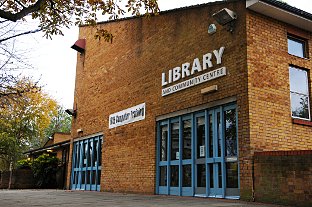
Big Society proposals for York Gardens Library

Author: Cyril Richert
The Council has been determined to reduce the library services and to pursue with its plan to shut down services at York Garden Library to save money.
However, the simple close of all services provided in the deprived area faced a strong outcry from local residents and deep concerns in other part of the borough. We were not the biggest voice against the targeting of this public service, but we published our opinion with an explicit title: Hall of shame.
Thus Wandsworth Borough Council was probably facing two sides:
- On the one hand it couldn’t withdraw a policy that it defended, without being seen as agreeing with the Labour opposition;
- on the second hand they heard the arguments and the opposition to what many considered as a completely unfair and unbalanced decision. [1]
During the meeting organised last December, Jane Ellison, Battersea MP, paved the way to the “exit-solution”, using the PR friendly idea set up by Conservatives spin-doctors: the “Big-Society” stuff (even on Conservatives websites they put quotes as nobody knows what it means exactly…).
It was confirmed on her website later as she wrote:
“Battersea’s MP has warmly welcomed the new proposals for continuing services at York Gardens Library which involve council staff, community groups, local schools and volunteers. “
A proposal was indeed presented before the Environment, Culture and Community Safety Overview and Scrutiny Committee on Monday, 28th February, 2011 and approved (by 6 votes to 0 with 2 abstentions from Labour Councillors).
The report from the Director of Leisure and Amenity Services on the Library Review, following public and stakeholder consultation, proposes:
- The introduction of reduced opening hours at all libraries (except Tooting).
- The development (on a trial basis) of a ‘Big Society’ pilot project at York Gardens Library using reduced staffing supported by volunteers (the aim is to still offer a children’s library service,with some adults’ provision, a homework club, public-access I.T. facilities and community space provision); the UK On-line IT training centre and its Tutor would transfer to Battersea Library [Option 4.]
- A report should be brought back to the Overview and Scrutiny Committee and Executive after six months’ operation (October 2011 to March 2012) in order to assess performance and any further development potential.
- The investigation of potential savings arranged with the involvement of private sector management of library services.
- Negative budget variations of £359,460 in 2011/12 and £718,920 in a full year
In a previous report, it was said that the Council would save £219,000 per year by closing the York gardens library only, but the cost to retain some service was estimated to be £92,000 (that would reduce the saving to £127,000 per year) ; on the other hand, the council could save £53,000 per year just by reducing the opening hours. It means the difference between closing the library and reducing the opening hours is just £74,000 per year (less than 59 pence extra per year in Council tax).
The Consultation
The result of the consultation on the future of the library service in Wandsworth showed that 1,201 Survey Forms had been submitted. 205 short surveys had also been created by the Save York Gardens Library Campaign. Stakeholders have also submitted Library Review Survey Forms on behalf of their organisations or communicated their views at meetings or via letter and email. A total of 184 letters and emails, including 12 from community or stakeholder organisations were also received by the Council.
Regarding specifically the York Garden library questionnaire, the analysis indicated that (from page 10):
- 71% strongly or tended to disagree with the closure of York Gardens Library
- 58% strongly or tended to disagree with closure plus an outreach service for children and moving the IT Learning Centre to Battersea Library.
- 40% strongly or tended to agree with reduced opening hours from 44 to 30 hours per week whilst 34% strongly or tended to disagree with this proposal.
In its report the Director agreed with most of the point raised by opponents of the closure. He wrote, for example, that “retaining some form of children’s library provision could be considered since, although alternative provision at Battersea Library is little more than half a mile away, it is recognised that access for families and children would be more challenging.“
The Big Society idea
The report also highlighted that Thomas’s Schools Foundation has expressed concerns on deprived elements of the community in the Battersea area. During a discussion with the Council representatives the Foundation expressed interest in offering support to, for example, maintaining a children’s library and homework club presence on the site of the York library (thus the “Big Society” aspiration).
Another opportunity could be to claim government’s support (meaning also funding!) to develop the idea of “Big Society” within public services’ staff who want to take over and run their services as mutual organisations (don’t ask me what it means exactly – not a clue ; public sector workers to volunteer to do the same work but unpaid?).
But, although trying to please Conservative aspiration, the Director is not naive and wrote (as a warning?) in its report:
“During 2009/10, the Service had 90 volunteers working in libraries, 50 were new and 40 continued from the previous year, representing a turnover of 55%. Experience suggests that, after initial enthusiasm, volunteer fatigue will develop and increased efforts will be required on a continual basis to maintain the pool of volunteers across the Borough. Some volunteers are out of work who then give up volunteering when they find employment. If Option 4 is approved, officers will look to establish the feasibility of recruiting suitable volunteers, in appropriate numbers, to develop a strategy for using paid staff and volunteers to maintain extended opening times.“
His report is however supportive of the option above, giving 2 reasons:
- The weight of interest from the public and organisations (ready to contribute to the running costs of a continuing library presence).
- The involvement of private sector schools, another and volunteers providing an opportunity to demonstrate the Tory idea of a “Big Society” project.
Cost and Savings
The savings target to be achieved could be the £127,000 saving of retaining some services vs closing fully, plus the saving of a full-time Senior Library Assistant of £28,915 per annum that were part of the Children’s Outreach service. This gives a total saving of £155,915 per annum.
However we can read further on that the pilot will only achieve the £155,900 saving if community lettings income and the partnerships with Thames Christian College and Thomas’s Schools Foundation are maintained. Should this not be the case then some of the operating costs may revert to the Council. The costs for converting the Library for use under the pilot are presently estimated to be £50,000 and will be contained within approved revenue budgets.
The consequences for the York Gardens library users
The decision is on a trial 12 months’ basis, consisting of use of the York Gardens building for:
- additional first-floor use for classrooms (while retaining bookable community space at non-classroom use times) by Thames Christian College, with associated additional income;
- accommodating the Learning Resources Service of the Children’s Services Department with an associated contribution to the building’s running costs;
- operation of a Homework Club on two or three evenings a week, supported by staff and volunteers;
- operation of a Children’s Library for 30 hours by staff including some limited adult stock (see paragraph 69 below for proposals regarding staffing structure) with support from volunteers;
- a range of public-access I.T. facilities;
- agreement of a partnership with the Thomas’s Schools Foundations for volunteers and any other resources available to support the Homework Club and Children’s Library as set out in iii) and iv) above; and
- maintenance of a lettable community space
[1] There is a statutory duty to provide a ‘comprehensive and efficient public library service for all persons to make use thereof’: Section 7, Public Libraries and Museums Act 1964.
Brighton Yard: New entrance at Clapham Junction station is open
Author: Cyril Richert
Wandsworth Council published a press release to announce the opening of Clapham Junction new entrance at Brighton Yard:
“The new step free entrance to Clapham Junction was officially opened today (Thursday) in a move that will help to ease overcrowding throughout the station.
The entrance building is based on St Johns Hill and leads directly into the station’s existing footbridge. From there passengers can access every platform via newly installed lifts.
The new route means thousands of passengers can avoid using the main entrance and subway tunnel which has become increasing congested in recent years.
The upgrade also means the station is now fully accessible to people with reduced mobility and much easier to negotiate for those with young children or heavy luggage. [...]
The entrance building includes ticketing facilities, travel information screens, toilets and shops. Outside the entrance a taxi and car pick-up and drop-off point has been created with cycle racks for up to 72 bikes. “
Although we much welcome the opening and are convinced that this goes in the right direction to improve the station and the facility, we have to highlight the irony of the Council’s statement saying: “the opening follows a seven year council campaign for a new station entrance which won backing from thousands of commuters and local residents“. Shall we just remind Wandsworth Borough Council that they worked and supported for five years the plan to erect two skyscrapers of 42 storeys, which was opposed by more than a thousand residents 2 years ago? [as seen in officer's report here and confirmed in meeting with Network Rail there]
One of the bottle neck issue and justification of last proposal to redevelop the station included the overcrowded subway. As we wrote in January 2010, Network Rail was expecting that the new entrance will direct 30% of the flow of passengers entering or exiting the station at St John’s Hill currently. In the press release the Council is confirming this figure talking of “as much as 25 per cent and create more breathing space in the jam-packed subway tunnel“.
Key figures are (funding):
- Department for Transport – £13.2m (through Access for All and National Stations Improvement Programme)
- South West Trains – £600k
- Wandsworth Council – £300k
- Transport for London – £300k
- Network Rail – £200k
- Railway Heritage Trust £75k
TOTAL: £14.675m
It is a substantial increase from previous figures as we wrote last year that the total amount could be ~£10m (£8.5m for the Access for All scheme previously allocated by the Labour government and the £1.5m to redevelop the entrance). The amount was slightly increased in the statement from the Council 4 months ago to £1.9m for the entrance. Apparently the government has decided to provide additional funding.
Read also our previous articles:
The Clapham Junction Action Group is committed to work with residents, political parties, businesses and all stakeholders to provide ideas for the redevelopment of the station. You can participate here (click).


Recent Comments