
Posts filed under ‘Ram Brewery’

Ram Brewery – round 3

Author: Cyril Richert

As expected (and well on schedule) a new proposal has been released last month.

New plans for the redevelopment of the Ram Brewery site in Wandsworth Town will be on public display this week.

The proposal is described on the developer’s website:

  • 558 residential apartments
  • Office space (7,218 sq m) located predominantly in the buildings adjacent to the stable block on Armoury Way
  • Heritage buildings (7,335 sq m)
  • Shops, cafes, bars and restaurants (5,093 sq m)
  • Showroom (1,222 sq m)
  • Leisure uses such as a pool, spa, gym (1,039 sq m)

  • Apartments come in a range of sizes to meet housing needs and demand in the local are
  • Upper level gardens will provide amenity space for local residents
  • There will be provision for affordable housing on site; the quantum is being discussed with the local authority
  • All residential buildings will meet the principles of ‘secured by design’ to enhance public safety
  • The design meets the required sustainability targets for residents buildings

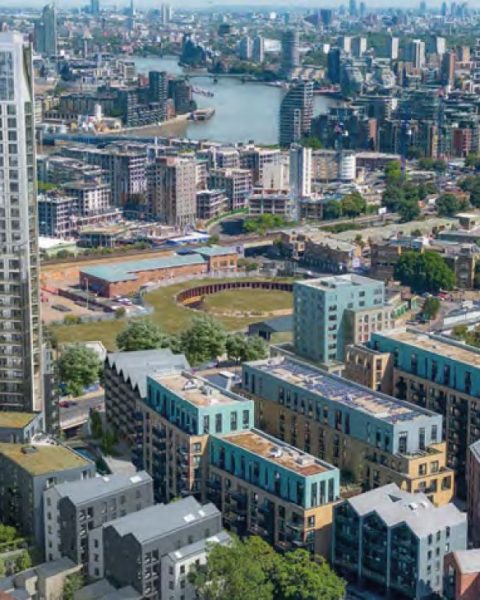
A predominantly residential tower is proposed on the Capital Studios site. The triangular form responds to the orientation of the site and gives a slender appearance on the skyline. The tower is located further west to reduce its impact on the view of the church when viewed from West Hill. When viewed from Barchard Street, the scale of the new buildings proposed in the foreground help to contain the space at street level. Across the main brewery site, residential apartments are spread out across the site.

An exhibition was organised by the developers at the Ram Brewery site on Thursday 30th June and Saturday 2nd July. The site’s owner, Minerva, will use the feedback to fine tune their designs before submitting a full planning application later this year. In parallel a website went live at the end of June in order to display the proposal.

Alternatively people can ask questions or provide feedback by email, telephone or post using the contact details below:

Freepost RSRG-LHZA-JULZ
Public Consultation (Cascade)
25 Floral Street
LONDON
WC2E 9DS
Telephone: 020 7868 5530
Email: rambrewery@cascadepr.co.uk

Ram Brewery, Wandsworth High Street SW18A the end of 2008 Wandsworth Council approved the original schemes including 2 skyscrapers up to 42 storeys.

In June 2010, the government refused the previous scheme including 2 residential towers of 32 and 42 storeys, following a 2 month inquiry and a report from the government inspector advising to refuse the application.

You can read our analysis of the reasons for refusal HERE. One of the main issues was the height of the towers. At the same time there was the issue of gas-holder that they would stand near to, and in the event of an emergency could take the direct force of a blast from, the last thing you possibly want a tall building to experience.

The developer Minerva has tried to show during the exhibition and on the website that they have listen to the government’s advice and taken into account the criticisms, filling the website with quotes from the Inspectors’ Report 2010.

The location of the new tower (which looks like ~32 storeys) aims not only to reduce its impact on the view of the church, but primarily to be further away from the gas holder, as shown in the comparison made by the architect below (click on the images to see bigger):


Emerging policy provided by Wandsworth Council in its latest Site Specific Allocation Document indicates that “in accordance with the Stage 2 Urban Design Study – Tall Buildings, the site is sensitive to tall buildings. The height at which a development on the site will be considered to be tall is 5 storeys“.

Developers will argue that we have already the Sudbury House, a 23 storey residential tower block above the Southside shopping centre; 3 more recent tower blocks, of much the same height, have been built along the western edge of the shopping centre; another new tower block, of similar height, has recently been constructed at its southern end. However the site consists mainly of the Capital Studios buildings (3 to 4-storeys) and residential units consisting of 4-storeys (with basements), stepping down to 3-storey buildings currently used as offices, a 2-storey
residential house and finally the Crane Public House is located on the corner.

No doubt that the Wandsworth Society will have a close look at the scheme and should make comment on the new plans.

July 9, 2011 at 5:42 pm Leave a comment

Site Copken House: planning permission granted

Author: Cyril Richert

In the decision made by the Secretary of State for Communities to refuse the Ram Brewery development (read our article here) he also agreed on planning permission for the smaller development of Copken House site (beside the Ram Brewery), subject to review of section 106.

The Secretary of State has decided to grant planning permission for demolition of all existing buildings and the erection of 5-16 storey buildings plus basement, made up of

  • a 5-storey building to the rear stepping up;
  • a 10-storey building along Buckhold Road;
  • a 4-storey element;
  • 16-storey tower facing King George’s Park;
  • a new pedestrian route to Hardwick’s Square;
  • the provision of 207 flats, 1010 sq m of commercial space including shops, community uses, offices, bars and restaurants;
  • the provision of underground parking for 78 vehicles and 206 cycles, on a site at Cockpen House, 20-30 Buckhold Way, Wandsworth, London SW18 4WW.

The Secretary of State said that, although the proposed scheme is not in accordance with those development plan policies which deal with the provision of affordable housing, and is also in conflict with national policy in this respect, he considered that the scheme would meet policy objectives relating to sustainable development and regeneration both in terms of local UDP policies and the London Plan. It would provide a significant quantity of high-quality, well-designed housing, and would contribute to the developing character and the regeneration of this part of the town centre.

He gives weight to the benefits offered by the s. 106 agreement, which include contributions to improvements in local transport and open space.

Regarding improvement of Wandsworth Town station, the redevelopment was already approved in August 2010, so well ahead of this decision. However it included a part stating that : “the scheme would be funded by Network Rail, South West Trains and the council has secured contributions from local developers as a condition of their planning consents (section 106)“. We wonder whether it was including the Copken House planning decision and if not, where is the money allocated with the SoS approval going now?

He has also agreed with the Inspector’s recommendation that the Cockpen House site does not front directly onto the gyratory system and its redevelopment is not necessary in highway planning terms. Therefore the gyratory contribution has not been shown to be necessary in terms of the amenity of future residents, or for any other planning reason.

Full decision available her (PDF).

November 13, 2010 at 12:19 am Leave a comment

New Ram Brewery plan expected early in the new year

Author: Cyril Richert

According to Brightside October 2010, a new application for the Ram Brewery in Wandsworth town centre is expected early in the new year.

Minerva, the company that owns the site, announced plans to submit a revised proposal following the Secretary of State’s decision to eject the previous scheme.

The firm said in its annual results published on September 21st:

The key issues revolved around the two tall buildings proposed and their location within the conservation area and proximity to a nearby gasholder. Most of the regenerative benefits created by the scheme were accepted, and will be reincorporated into the next planning application. Accordingly, a new scheme is being designed to reflect the planning inspector’s and secretary of state’s comments. It is expected that a new planning application will be ready for submission during this financial year.

They also said on their website that “A revised application is now being worked on, keeping much of what was originally envisaged and accepted as a positive contribution, but with revised proposals for the tall buildings.

According to skyscrapernews.org, as the company correctly points out in its full year results, one of the main issues was the height of the towers, and thus it can be expected that any new planning application will see these severely reduced. At the same time there was the issue of gas-holder that they would stand near to, and in the event of an emergency could take the direct force of a blast from, the last thing you possibly want a tall building to experience.

One possible solution to this could be similar to that seen at Battersea (Nine Elms development area) where an office building was placed next to the gas-holders to provide a barrier element between them and residential housing.

It is the occasion to read again our article on the Ram Brewery verdict: analysis of the government’s refusal. There is no doubt that any further plan will be scrutinise in the light of the Secretary of State’s decision in term of size, density, character, location and affordable housing.

You can also see our full dossier on the Ram Brewery here.

September 30, 2010 at 10:47 am Leave a comment

The Ram Brewery verdict: analysis of the government’s refusal

>> Your chance to contribute: tell us what your think on Clapham Junction station redevelopment

Author: Cyril Richert

As I wrote on Thursday, the report of Colin Ball, the Inspector on the Ram Brewery Public Inquiry recommended that Application for erection of 2 towers at the northern end of the Ram Brewery site up to 32 and 42 storeys in height along with a number of additional middle size buildings in the site should be refused. The Secretary of State agrees with the Inspector’s conclusions, and agrees with his recommendation. It followed a month-long public inquiry last November, after the decision of Wandsworth Council was called-in on the request of the former local MP, Martin Linton.

I received the full report of the inspector: 214 pages. I will spare you comments on each single page, first because this article would become a novel size, and second because you should better enjoy the weather outside, the tennis/football this weekend and whatever other activity you might have chosen.

Supporting the analysis you will find here the reports:

I have decided to flip through the report of the Inspector to extract the considerations regarding the same points I raised in the CJAG evidence: tall buildings, transport, community benefits; beside I will also comment on the position on affordable housing and safety issue regarding the proximity of the gas holder that happened to be so controversial.

Tall buildings

Applicant images

A lot of time has been spent on the Applicant Visual Representations of the scheme. Criticisms have arisen on the quality of the images presented by the applicant. The Wandsworth Society has hired an independent expert and spent money on producing evidence on the real perception of the impact of the buildings. Despite the many attempt to discredit the work produced by the Wandsworth Society, the advocate representing Minerva (the applicant) lost the point as the inspector wrote clearly (p7):

Guidance on how to prepare AVRs consistently indicates that images should ideally be made within a 40° field of view (FOV); beyond that, the perceived shapes of surrounding buildings may be distorted [...]  the use of a wide angle lens has the effect of distorting perspective and distance, and thus the spatial relationship between foreground and background. Existing buildings, and therefore the new ones, appear further away or smaller than they are or would be in reality, This was particularly apparent to me when I compared the AVRs to the actual views from the same viewpoints and is also demonstrated in the Wandsworth Society’s comparable 40º AVRs.

[...] the applicant’s AVRs cannot be taken as accurately representing what would be seen by the human eye.

You may recall that last year, along with the Wandsworth Society, the Putney Society and the Battersea Society we have submitted a joint statement on tall buildings where we specifically said:

“Appropriate publicity should be agreed with Council Members and officials at the pre-application stage and should use images which demonstrably reflect the true appearance, height and mass of the development measurable against neighbouring buildings.”

This was definitely not the case here for the Ram Brewery, as highlighted by the Inspector, and it was also a clear criticism of the twin towers proposal for Clapham Junction station where the same trick with wide angles was used by the developers.

Conservation area and the effect of tall buildings

Emerging policy provided by Wandsworth Council in its latest Site Specific Allocation Document indicates that Wandsworth town centre is appropriate for tall buildings. Indeed you have already the Sudbury House, a 23 storey residential tower block above the Southside shopping centre; 3 more recent tower blocks, of much the same height, have been built along the western edge of the shopping centre; another new tower block, of similar height, has recently been constructed at its southern end.

The SSAD says (p59):

Here, buildings of 12 storeys and above will be considered against the DMPD tall buildings policy and buildings or more than 30 storeys will generally be considered inappropriate, and only considered in exceptional circumstances. [...] In December 2008, the Council resolved to grant planning permission for a development that includes 32 and 42-storey towers, which are considered exceptional in terms of design and their context and therefore acceptable.

In presenting its case, the developers explained that the view from Wandsworth Park would be significantly enhanced by the ability to see two quality towers which will allow the park user to know and understand the position of the park in its wider London setting (probably because park users are so dumped that they need big marks to visualise where they go from far away! – sorry, I’m just joking here).

They also tried to argue that the visual impact of the towers would be limited because they would be so slender. In fact the plan dimensions of each tower – width and breadth – would be substantially greater than those of Sudbury House, itself a large block of fairly squat proportions. This is a clear illustration that any perception of slenderness would be simply a reflection of the fact that the towers would be so much higher. The towers would be very large buildings.

Here the Inspector starts by acknowledging that regrading the existing there is a justification for taller buildings in the area:

It is therefore likely, and perhaps inevitable, that new buildings on sites within traditionally built areas of modest scale will be higher and more closely built-up. What matters is not so much the size and scale of new development but how well integrated it is into its surroundings in both functional and visual terms.

However he cut sharp any hopes for the applicants, writing also:

Here I consider that the huge differences in character, size, mass, scale and appearance are such that the contrast between the stable block and the towers would be particularly jarring. There seems to be no account taken of the specific character of the stable block or how that might influence the layout, and no designed relationship with the towers to successfully integrate it into the scheme, within an appropriate setting. [...] There would be a similarly jarring contrast as with the stable block between the tower blocks and the locally listed houses in Barchard Street to the east and the public houses and houses, including the listed Wentworth House, centred on Dormay Street to the west. There has been little consideration given to the impact of the development on these small-scale buildings, and there would be clear harm to the character and heritage of the area, in conflict with UDP Policy GEN6. [...] I consider that, at this northern end of the site, the development would have a poor relationship with the surrounding area.

He added:

It is vital the new buildings should fully respect the character and setting of the old, especially when they are of such outstanding interest. Here, as the AVRs show, not only would the characteristic skyline be lost but the new buildings, and particularly the towers, would utterly dominate the scene, changing the townscape character and undermining the quality of the setting of All Saints Church and Church Row.

In addition the Inspector criticised the design itself, talking about the prominence in longer views, the rhythm on the façades which will confuse the perception of scale and the top of the towers which appears to be arbitrarily “sliced off”. Therefore he concluded:

For these reasons I find the quality of design of the towers to be somewhat lacking.

It is clearly demonstrated that most of the problem is created with the two huge towers. On the rest of the development, the Inspector considers that they would be appropriate to the town centre location and would be well integrated into their surroundings.

It is clearly demonstrated that most of the problem is created with the two huge towers. On the rest of the development, the Inspector considers that they would be appropriate to the town centre location and would be well integrated into their surroundings.

Public Transport

The CJAG, along with other opponents, was defending the case that Wandsworth station is already running over capacity, that trains are so crowded that passengers sometime prefer to catch a train in the opposite direction to get a chance to board on their train, and that alternative routes using Clapham Junction couldn’t be seriously envisaged as this station is already branded the second worst in the country.

However here the Inspector does not join our views as he wrote:

At Wandsworth Town station, the existing and more critical am peak train loadings are high and, from the Assistant Inspector’s site visits, the data presented to the Inquiry is reflected in conditions at the station. The travelling conditions are however not unusual for inner London, and the trains only appear to be uncomfortably full for a relatively short period over the am peak and only for the early part of the journey into central London. [...] The increase would be sufficiently small to not be noticeable, and I consider that there would generally be sufficient capacity over the peak period to accommodate such an increase.

Of course this is disappointing. In its visits, during a short period of time, the Inspectors have not seen what many people have complained about, and that was even recognised by the government when it named Clapham Junction (suggested as alternative use by the applicants) as one of the station in urgent need for investment. The explanation for this mis-perception might be read with the Inspector saying:

Furthermore, there was no objection to these figures from the Council or the Mayor at the Inquiry. I therefore accept the figures put forward.” In its case, the developer actually said: “at Clapham Junction, most of the 40 trains to London in the am peak hour have passenger loadings below 80% and these are below 70% leaving Vauxhall to Waterloo“.

Maybe we should appoint our own study, but how and with which money? There is undoubted facts that the Council has however acknowledge the need for improving the rail stations in the area, with £300k allocated to CJ station Brighton Yard entrance and the announcement of £250k allocated to contribute to Wandsworth Town station refurbishment (but that was before the budget cut!).

Community Benefits

As the CJAG highlighted in its evidence, there was not much detail on the £41 million contribution that the developers were giving at the time the application was approved by the Council, except a vague consideration on the fact that most will be allocated to sort out the gyratory system. Actually, the Borough policy says that “buildings or more than 30 storeys will generally be considered inappropriate, and only considered in exceptional circumstances” (SSAD p59) ; the example of such circumstances is given of a significant infrastructure investment to solve current traffic issues. The Public Inquiry showed that the application was submitted in its current form without any such investment in mind – it was incorporated later – but no other exceptional circumstances were put forward with the application to justify such tall buildings.

Affordable Housing

As the CJAG also wrote in its evidence, for all new development (although depending on site circumstances) the expectation is a provision of between 33% and 50% affordable housing. In this scheme, the 11% total provision of affordable housing falls far short of even the lowest level of policy aim. The Inspector cannot do anything but say that it is therefore clear that the affordable housing provision that is proposed does not comply with the aims of LDF Policy IS5 or those of the London Plan.

But even more, he noticed that the level of affordable housing is concentrated exclusively in the Cockpen House site (on a different application), with none in the two huge towers. Therefore he commented that:

There would be a complete lack of affordable housing on one site and an over-concentration at the other. [...] This would undermine national objectives to promote development that creates cohesive communities.

And this is is main concern for the Inspector on this aspect. Although the Wandsworth borough is only 24% affordable housing (!), the town centre has a level of 42% (mainly due to the group of tower blocks in the estate behind Southside) and the proposal would change that proportion to 31%, still above the borough average (that will lower down too). We could argue noticing that that fact that Wandsworth is already a poor performer on affordable housing is not an excuse but we will keep his argument on mix communities and we agree with his conclusion saying:

However, the concentration of all the affordable dwellings at the Cockpen House site, where they would form the majority of the development, could be socially divisive. What is more, the proportion of affordable dwellings, at just 11% of the total, is unacceptably low. I consider that there would not be an acceptable provision for affordable housing. [...] However, the applicant contends that this harm is outweighed by the benefits of the proposals, and is supported in this view by the Council and the Mayor. I consider the overall planning balance below but, in the terms of PPS3, [...] the proposal would not meet either London Plan or emerging local targets for the proportion of affordable housing to be provided. To that extent, I consider that the proposed development would not fully accord with national planning policy guidance in PPS3 Housing.

Gasholder

The Inspector is a little bit bemused that the Stage 2 Urban Study makes no mention of this possible restriction in setting out the Opportunities and Constraints for Tall Buildings at the Ram Brewery/Capital Studios site and gives a strong indication that tall buildings should be located at the northern end of the site (also SSAD p59). Everything is displayed as there is no gasholder in the area or that no restriction has to be taken into account. He wrote:

The proposed towers would be situated in the most sensitive part of the site in relation to the gasholder. [...] There is no evidence that safety has been a significant consideration which was taken into account in the design of the proposed development, and it therefore would conflict with paragraph 4.96 of the draft Core Strategy, to which I give significant weight” (but as shown above, to which the Council itself did not)

I will pass through the several pages talking about the probable risk (10 out of 1 million per year), the confidence level (90%), Scaled Risk Integral (which exceed the threshold by a factor of 18), HSE’s frequency analyses using the Poisson and the n+1 approach, the decision made for the development at Oval (the Inspector found this is of limited relevance). The Inspector concluded:

The proposal would have a harmful effect on public safety with regard to the proximity of the Wandsworth gas holder, and that it would thus conflict with national policy on hazardous installations as set out in DETR Circular 4/2000 Planning Controls for Hazardous Substances.

Overall the Inspector recommended only refusal of the Ram Brewery scheme including the towers, but allowed the demolition of other buildings in the area, and the application for the Cockpen House site (five buildings from 5 storeys stepping up to 10/16 storeys), although upon a series of conditions.

Secretary of State refuses planning permission for the Ram Brewery site

To summarize the Secretary of State decision:

  1. He considers that the proposed development would have an unacceptably harmful effect on the character and appearance of its surroundings, including important historic assets.
  2. He considers that the 11% affordable housing provision which is offered is unacceptably low.
  3. He considers that the public transport system would be able to cope with the extra demand placed on it by the proposed developments.
  4. He considers that the proposal would also conflict with national policy on hazardous installations.
  5. He does not want to comment on the gyratory system contribution as he finds it irrelevant in the context of the refusal.

Going further than the Inspector’s recommendation, the Secretary of State decided also that it “would be premature to grant conservation area consent for the demolition of the modern buildings on the site in the absence of any information about what shape future proposals might take” and therefore refused also planning application. However he agreed on the planning application for Cockpen House. Considering the fact that this application was deeply linked with the tower scheme (especially in term of affordable housing) he decided to grant permission subject to conditions and to submission to a new s106 agreement. He has given 6 weeks for the applicants to do so (followed by a 2 weeks consultation period). He will issue a final decision by the end of September on this latest application.

And now?

Despite his refusal of the proposal, the inspector encouraged the Council to pursue its effort to redevelop this part of the Wandsworth, saying (p6 of the conclusions):

Both sites can be fairly described as under-used, town centre brownfield land. As such they should be a priority for redevelopment. They are effectively the only available sites within the town centre which can provide a significant opportunity for regeneration. The inquiry showed widespread public support in principle for the proposed mixed-use redevelopment of the sites, with universal approval of the retention and re-use of the brewery buildings.

The Inspector gave also his views in the development of the town centre, saying:

In my view, the density of residential use is not the only, or necessarily the best, indication as to whether a development maximises the potential of a site, especially in a mixed use scheme. The contribution of the retail, leisure and commercial elements of the scheme to the vitality and viability of the town centre, including the reuse of important historic buildings, is equally important. This is crucially a matter of balance, with the aim of achieving the maximum intensity of use compatible with local context. [...]

I consider that in principle the Ram Brewery site would be a suitable location for tall buildings in general accordance with the locational criteria of Policy 4B.9. [But overall] the proposals would not meet the pivotal criteria requiring high quality design and respect for local context.

In presenting its case to the Inquiry, the Council considered that the benefits of the proposed schemes were overwhelming, and far outweigh any negative aspects relied upon by the opponents of the scheme.

After one of the biggest public inquiry organised for a planning application in London, the Secretary of State has joined the Inspector who agrees on most of the claims raised by the Wandsworth Society along with other interested parties. It’s time to go back to the “drawing board” and pay better attention to the local resident views, as it shows here that contrary to the Council they were right to oppose this application.

According to the article published by Wandsworth Guardian, Minerva’s chief executive, Salmaan Hasan, said:

We are naturally disappointed by the Secretary of State’s decision and remain committed to our Ram Brewery and Buckhold Road sites, which represent a rare opportunity to regenerate Wandsworth town centre. However, the Secretary of State has given a positive response to many aspects of the scheme and given guidance as to what is likely to be acceptable. We will now consider the information and guidance in the Secretary of State’s response and review our options as we look to move the scheme forward.

Indeed any new plan will be scrutinised in view of the report produced by this Inquiry.

It is always dangerous to use radical slogans, as it could backfire. The Council presented the redevelopment of the site as a “once in a lifetime opportunity“. It has now to work to prove its statement wrong and deliver a better plan for the regeneration of the town centre within the next… 80 years? Even if the people who fought this plan have the right to crow, I have no doubt that their priority will be to work with the Council to make Wandsworth Town a better place for everyone.

July 4, 2010 at 10:38 pm 9 comments

Ram Brewery: towers refused by government

>> Your chance to contribute: tell us what your think on Clapham Junction station redevelopment

Author: Cyril Richert

We have just received the decision of the Secretary of State regarding the Ram Brewery redevelopment plan Inquiry.

I will just copy below the main decision regarding the scheme with skyscrapers and will develop some analysis later (as soon as I have time this weekend).

Application A:
erection of 8 new buildings comprised of 2 towers at the northern end of the Ram Brewery site up to 32 and 42 storeys in height with retained listed stable block and new 3-storey building fronting Armoury Way; 2-9 storey buildings consisting of 4 residential blocks above first/second floor level… etc

The Inspector recommended that Application A should be refused. For the reasons given below, the Secretary of State agrees with the Inspector’s conclusions, and agrees with his recommendation.

Link to the report of the inspector

Link to the decision of the Secretary of State

July 1, 2010 at 9:28 am 9 comments

Ram Brewery decision delayed: now 17 June

Author: Cyril Richert

Back in December 18, 2009 I wrote: “Ram Brewery: the Secretary of State could make a decision before next election“. In view of the date for the decision (before May 27th) I was much too optimistic and Tony Belton was right to point out that in his view it was delaying the decision after the election, for the new Secretary of State (good luck fellow!).

Yesterday I received the following letter (see PDF here) saying that:

the Secretary of State will not be in a position to reach a decision on this appeal [Ram Brewery] by 27 May. This is because of the general election and the need, following that election, for any new Ministers to be briefed on planning casework. Therefore [...] the Secretary of State hereby gives notice that he has varied the timetable previously set and he will now issue his decision on or before 17 June 2010.

April 24, 2010 at 1:44 pm Leave a comment

Ram Brewery: the Secretary of State could make a decision before next election

Author: Cyril Richert

Sian Evans, the Secretary of State, has published a statement regarding the Ram Brewery Inquiry with an apparent intention to issue a decision before next general election (due by June 2010 at latest). [*]

Following the closure of the Inquiry, the Inspector is now preparing his report and recommendation(s) for submission to the Secretary of State for their consideration.

In accordance with Schedule 2 to the above Act, I am writing to let you know that the Secretary of State will issue their decision(s) on or before 27 May 2010.

In any case, it could mean that we are likely to have a recommendation from the Inspector early May 2010.

Read also our article: Ram Brewery Inquiry is over: what next?

[*] That’s the usual story of the glass half full or half empty: you could think also that a general election is likely to happen before the decision.

December 18, 2009 at 4:46 pm Leave a comment

Ealing town centre gets a reprieve

Author: Shirley Passmore

We learned this week that the Secretary of State has refused planning permission for a development in Ealing town centre for a 25-storey tower and 6 further blocks of between 2 – 11 storeys, by architects Foster and Partners (full report HERE).

A piece of very good news for the Wandsworth objectors (ie. most of the local population of all political parties and none) is that the formidable Russell Harris QC [representing Minerva in the Ram Brewery Inquiry], who conducted the case for Minerva and was also the QC acting for Glenkerrin at Ealing, did not win. We thought he might be unbeatable!

The proposed scheme is different from that for the Ram site in many respects but there are interesting similarities. The area around the site is similar to Wandsworth, a mixture of very old, of Victorian (2-6 storey), and more recent buildings of doubtful merit. There are also many listed buildings nearby.

The main differences are that the proposed tower is ‘only’ 25 storeys high and there is only one. The proposed density for the site is way above the highest required level in the London Plan, and Ealing is categorised as a Metropolitan Centre as opposed to a Major Centre for Wandsworth.

However, euphoria over the result must be dampened down somewhat because, as one reads through the inspector’s report, one wonders when he will find anything to oppose. It is a glowing appraisal of the benefits of landmark towers and their suitability on town centre sites, of the benefits that very high density can bring, and of how the scheme conforms to the London Plan and Ealing’s UDP in nearly every way.

We are soon made to understand that any thoughts that well-researched objections to density, building standards, lack of public open space, traffic generation, poor public transport, wind around towers, retail needs, affordable housing, parking spaces, etc etc, might because for rejection is in the realm of wishful thinking. They were all considered but brushed aside.

Feeling more and more depressed but realising that there must be a rainbow at the end one comes to paragraph 685. Ah, at last!

Here PPG 15 is spelled out ‘environmental stewardship demands protection of the historic environment’, and London Plan Policy 4b1. requires that ‘development proposals should protect local history, context, built heritage, character and communities’ and finally in paragraph 797 (of 802)

Notwithstanding these clear benefits [as defined throughout the report] the design would be inappropriate in its surroundings, and would fail to preserve or enhance the character or appearance of the Town Centre conservation area…

Para 802 recommends refusal by the Secretary of State. He said:

Notwithstanding [...] clear benefits, I consider that the bulk, massing and certain aspects of the design would be inappropriate in its surroundings, and would fail to preserve or enhance the character or appearance of the Town Centre conservation area, and the setting of Haven Green conservation area, for the reasons set out in full in my consideration of the main issues. The massing of development facing Haven Green, and the elevations to Ealing Broadway are of particular concern. The height of the southern elevation of the scheme would in my judgment also harm the setting of the Grade II* listed Church of Christ the Saviour, diminishing its role as an important Town Centre landmark. While I accept that, considered in isolation, the design of the proposed tower is of high architectural quality, I consider that it would not contribute to the distinctiveness and identity of Ealing, and would be dominant and overbearing in the predominantly low rise context of Ealing Town Centre and development surrounding Haven Green. [...]

I recommend that planning permission for the application should be refused.

It is clear to see why Russell Harris is in great demand by developers at Public Inquiries. His documented case takes every objection, however slight, and pulls it apart in a logical and clear manner. However, he is not immune to picking policies from either current or emerging plans to suit and then suggesting the one not chosen is irrelevant. He also shows his irritation with the “articulate and educated section of the community” whom he thought “wasted much time over issues not identified by the S of S“.

So in the end it all came down to landmark towers being suitable in the right place but heritage and local context comes first. Hooray. Let us hope our inspector comes to the same conclusion.


The decision follows a public inquiry earlier this year into the high-rise £500 million project backed by developer Glenkerrin which would have created 567 homes.

The Secretary of State agreed with the planning inspector that the development of the 1.7ha plot would have had a ‘dominant and overbearing impact’ on the area and ‘seriously detract from [its] distinctiveness and identity’.

After winning the Mayor of London’s backing earlier this year, the whole project was called in by previous Communities Secretary Hazel Blears.

More:  architectsjournal.co.uk

John Denham’s conclusions (click to download full decision)

The Secretary of State considers that, although the application proposal is broadly in compliance with the development plan in many respects, there are significant areas of conflict, most particularly in relation to design principles and conservation. He also considers that the proposal does not fully accord with national policy in PPS1 and PPG15 in these respects. He has therefore gone on to consider whether there are material considerations of sufficient weight to overcome these.

He acknowledges that the proposed scheme would deliver a number of substantial benefits and fulfil some important objectives of development plan policy by contributing strongly to the Council’s regeneration objectives including reinforcing the status of Ealing as a Metropolitan Centre. The scheme would include, among other benefits, a landmark tower of high quality design and attractive pedestrian streets and spaces which would improve the permeability of the site. It would also deliver a significant volume of housing. Against these benefits, however, the Secretary of State considers that the bulk, massing and certain aspects of the design of the scheme would be inappropriate in its surroundings. It would fail to preserve or enhance the character and appearance of the Town Centre conservation area and the setting of the Haven Green conservation area, as well as harming the setting of the Grade II* listed Church of Christ the Saviour.

In coming to his decision, the Secretary of State has taken full account of the views of CABE in their support for the quality of the proposed buildings and streetscape improvements that the proposed scheme would deliver. However, he notes that CABE’s views did not include consideration of the way in which the scheme would relate to its wider surroundings, and he regards that as a key design objective of PPS1. He sees it as essential for the design qualities of the proposal to be considered in context, and he considers that its dominant and overbearing impact would seriously detract from the distinctiveness and identity of Ealing Town Centre and the Haven Green area.

Overall, therefore, the Secretary of State concludes that, although the scheme would comply with some specific development plan policies relating to the regeneration of Ealing Town Centre and would bring many benefits to the area, these are of insufficient weight to determine the application other than in accordance with those national and development plan policies relating to conservation and design in order to ensure that the distinctive existing character of the area is maintained.

December 10, 2009 at 4:54 pm 3 comments

Ram Brewery Inquiry is over: what next?

Author: Shirley Passmore

The Public Inquiry is over. To be honest, much of the time was taken up by anything but the public’s views on the proposed re-development of the sites.

The Wandsworth Society was given a fair hearing of its case against, but the rest of the local public was relegated to one day out of the 20 days of actual inquiry time.

All individuals spoke, and listed, very good reasons for asking the Inspectors to recommend refusal to the Secretary of State. Some, I think, said things that the SofS will have to consider seriously, included amongst these was Cyril Richert’s paper for the Clapham Junction Action Group.

Lined up against the public’s amateurs were three QC’s. The most formidable was Russell Harris for Minerva, who has won numerous similar Inquiries. The Wandsworth Society did not go on the final day to hear his summing up. To listen to his, no doubt competent, attempt to destroy the public’s case would have been too depressing.

There were six main issues to be resolved:

1. Did it comply with Governmental, Regional, and Local Planning Policies for the area?

2. Was it acceptable not to provide an adequate number of affordable homes or a mixed community (by having a majority of one-bedroom flats, no family homes, and the affordable homes on one site only)? Did the development conform to good design and standards for housing ?

3. Could the transport system cope?

4. Did the proposals contravene all the Planning Policies that seek to protect the historic environment and, in this case, the many listed buildings on the site and surrounding it? Would it have an adverse effect on the setting and character of the Wandsworth Town Conservation Area?

5. Was it unsafe to put a glass tower of people next to a gasholder of potentially explosive methane gas?

6. Was it acceptable to approve a possibly unacceptable (in planning terms) development because it might provide enough funds to remove Wandsworth’s gyratory road system?

When will we hear the decision and what will it be?

Neither question is answerable but we can at least hazard a guess. The first is the simpler. It is unlikely that it will take less than three months, probably considerably longer because of the complexities of some of the issues.

The second…..who knows?

All the Planning Policies relating to Issues 1, and 4, are open to interpretation. The Wandsworth Society and individuals put forward telling evidence of the environmental damage that will be done but it’s largely a matter of opinion…. The inspectors, the public’s, Minerva’s.

Issue 3 was won by the public. As things stand it is obvious that the public transport system cannot take yet more development in the area. But, of course that depends on the outcome of Issue 6.

Issue 6 will probably decide the result of Issue 2 also. Ironically, Issue 6 is not part of the planning application but an add-on to make it acceptable. The most telling admissions from witnesses for both WBC and the GLA was that without the road proposals they would not have recommended approval.

The most complicated and time-consuming issue of the whole Inquiry was Issue 5, the case against put by the Health & Safety Executive. It is accepted that the likelihood of the gasholder exploding in a fireball is not great, but the trouble with anything that might happen once in a thousand years is that you never can tell when the ‘once’ will happen. Debate revolved around how serious the results of an explosion would be.

If the HSE have won their case the proposals will be refused planning permission . If the Inspectors feel strongly that the development is unacceptable for other reasons, they have enough Planning Policy ammunition to shoot the proposals down. On the other hand, the benefit of any doubt has to go to the developer because the local planning authority (WBC) and the GLA / Mayor of London have (to their shame) already approved these proposals. Proposals that will alter the character of Wandsworth, both the town and the borough, for ever.

December 5, 2009 at 2:02 pm 3 comments

Ram Brewery inquiry: report on week 5

Author: Shirley Passmore

This week, week 5 of the Inquiry, will firstly be about what is called the Section 106 agreement between the council and Minerva on how much money will be forthcoming, and when, for a variety of requirements made necessary as a result of the development, plus other money used as a kind of bribe to get the proposals acceptable. This latter is £38,000,000 for removal of the Wandsworth gyratory system. There has to be a legally binding document. and as at last week, we believe this had still to be settled. Then there will be discussion on what conditions should be made if the Sec of State decides to grant permission.

On Wednesday there are to be site visits by the inspectors with, among others, representatives of the objectors .

On Thursday, probably the last day,the legal teams will sum up their cases. Firstly the HSE lawyer, then Mr Hobson QC for the London Mayor. He will be followed by Mr Cameron for WBC, and finally Mr Harris QC for Minerva who has the last word.

It has been a long, sometimes tedious Inquiry, but the inspectors can be in no doubt that local people do not want massive towers looming over them and stealing the sky. Whether the inspectors can agree with us that the proposals do not conform to enough planning policies to warrant refusal, only time will tell. I think we shall have some months to wait.

December 1, 2009 at 8:09 am Leave a comment

Older Posts


May 2012
M T W T F S S
« Mar    
 123456
78910111213
14151617181920
21222324252627
28293031  

Categories

Recent Posts

Feeds


Follow

Get every new post delivered to your Inbox.